Towards sustainable mobility
Towards sustainable mobility
Representing 7.2 million inhabitants, the Metropole du Grand Paris is a densely populated, urban inter-municipality comprising the city of Paris, 123 communes in the three départements of Hauts-de-Seine, Seine-Saint-Denis and Val-de-Marne, and 7 communes in Essonne and Val d'Oise. As Europe's leading employment hub and office park, it is a major vector of global growth.
Every day, the Metropolis of Grand Paris Metropolis asserts itself as the driving force and unifying element behind a host of metropolitan initiatives.
Emblematic examples include the acceleration of energy transition initiatives, the improvement of air quality through support for the replacement of polluting vehicles, the development of bicycle paths, the introduction of an electric vehicle recharging network, and the three editions of “Inventons la Métropole du Grand Paris”, which seek to create innovative urban projects.
In all these areas, Equans France, through its various entities, is supporting the various players in this change by promoting the development of more sustainable mobility, notably through the advent of intelligent transport systems and the creation of new-generation communication networks.
The revolution in intelligent transport systems: CAD/AVL (Computer-aided Dispatch / Automatic Vehicle Location)
Ineo Systrans, a subsidiary of Equans France, designs and develops a set of solutions including equipment, software and intelligent transport services.
An expert in Operational Assistance and Passenger Information Systems , the NAVINEO offer aims to optimize the operation of public transport networks in order to improve the attractiveness and performance of sustainable transport.

Through operational efficiency, safety, passenger experience, and data analytics, Ineo Systrans implements complex systems, contributing to efficient mobility and improving users' quality of life.
The CAD/AVL was specifically designed for transport operators to ensure and improve the supervision of vehicle fleets and drivers.
Thanks to its real-time information relay and geolocation capabilities, it facilitates operational management, whether it involves vehicle and driver assignment, real-time monitoring of service delivery, or managing unforeseen events along a route.
This system also improves the passenger experience by providing them with reliable information in real time, whether they are on board, at a stop, or on their phone. This information is disseminated via various media: display screens and audio announcements in vehicles and at stations, as well as via web applications provided by the transport network operator.
Building the journey of tomorrow
In a study conducted by Equans France to understand the expectations and habits of public transport users, several avenues emerged.
The survey results highlighted users' high expectations for the efficiency (punctuality, reduced delays) and comfort (less crowding, cleanliness, more pleasant journeys) of public transport.
Indeed, the majority of respondents cited efficiency as a priority (67%), while nearly half cited comfort (49%). Those surveyed who did not use public transport explained their choice by stating that they would be more inclined to use public transport if it were more comfortable, faster, more direct, more geographically widespread, and, above all, less expensive.

In conclusion, future expectations revolve around more comfortable, innovative, environmentally friendly, and safe mobility. Equans offers solutions to meet these needs through operating assistance systems, electric vehicles, and innovations to improve the fluidity, safety, and efficiency of transport.
The modernization of the CAD/AVL equipment onboard buses in the Grand Paris metropolitan area (the Île-de-France bus networks represent more than 10,000 vehicles) now makes it possible to implement new features that improve vehicle operations (quality of service, performance, and costs) (more precise location, passenger counting, more comprehensive information feedback, remote software updates, enhanced driver console, etc.), as well as passenger information (new on-board screens for improved service quality).
This major project is part of the opening up of competition by Île-de-France Mobilités by 2026. The modernization of the CAD/AVL systems will facilitate the transition of buses to the new operators' networks.
A modernized bus can be put into service by its future operator with minimal adaptation of the NAVINEO CAD/AVL hardware and software. This capacity offers a significant economic advantage for the region, which covers the transition costs linked to this opening up of the historic network to competition.
Low-carbon mobility
The metropolitan area continues to place a high priority on low-carbon mobility projects, as evidenced by the all-electric bus line, Tzen 4, in Essonne, one of the most innovative routes.
It relies on an electric HLSB (High Level Service Bus) vehicle, integrating, among other things, the latest version of the NAVINEO CAD/AVL solution and a Passenger Information solution from a partner company. The 30 vehicles on the future line will be capable of carrying up to 140 passengers, compared to 100 for current buses.
Regarding the trams operated in the metropolitan area, approximately 250 have been equipped with NAVINEO solutions on lines T2, T3, T5, T6, T7, T8, and T9. As for tram-trains, Equans France teams have installed these solutions on 80 trams on lines T4, T11, T12, and T13.
Today, in the Grand Paris metropolitan area, more than 11 tram/tram-train lines and over 10,000 buses (over 40% of which run on clean energy) are equipped with NAVINEO equipment or a solution, illustrating the expertise of the Equans teams and their contribution to the sustainable and innovative transformation of tomorrow's urban mobility.

“ Thanks to our NAVINEO Operational Assistance and Passenger Information System, our customers in the Paris Metropolitan Area have seen an increase in bus and tram ridership. By equipping a large fleet, NAVINEO optimizes network management, making services more fluid and improving the user experience, while also strengthening the attractiveness of transportation. We are proud to contribute to making mobility more sustainable, accessible, and efficient. ”
Very High Speed Network, one of the communications networks carrying the largest and most complex video streams in Europe
In 2014, Equans, through its entities Ineo UTS, Ineo Infracom, and Ineo Tinea, launched the Very High Speed Broadband Network project alongside Nokia and RATP.
Capable of supporting all RATP services—from surveillance cameras and telephony to a TETRA system (a professional mobile radio system used primarily for secure and critical communications) and the data service of the new VMS (Video Management System, for managing video surveillance applications)—the RTHD network consists of more than 2,000 switches/routers deployed at over 500 RATP sites in the Île-de-France region.
Metro stations, bus stations, commercial buildings, RER stations, maintenance workshops and even command posts responsible for traffic regulation or security: all now benefit from this new generation technology which significantly improves the performance of communications and the system.
The key is the ability to transport voice, data and image streams, including the most critical, with extremely high requirements on real time, flow rates and availability, thus increasing both diagnosis and responsiveness in the event of an alert.
After handling the design, installation, and integration of the video infrastructure and software for the entire network, Equans ensured the operational maintenance of the system and video infrastructure.
Today, RATP's security PCs have access to more than 13,000 cameras, which can be viewed continuously in real time thanks to a secure and redundant network.
Le projet RTHD porté par la RATP, Nokia et Equans France c'est :
Le projet RTHD porté par la RATP, Nokia et Equans France c'est :
Tram and TER: a boom to be supported
Rail projects, whether for tramways, regional express trains, or other infrastructure, play a central role in this transition to more sustainable mobility. Bouygues Energies & Services has implemented ambitious initiatives aimed at strengthening public transportation services while promoting soft, environmentally friendly mobility that meets the growing needs of users.
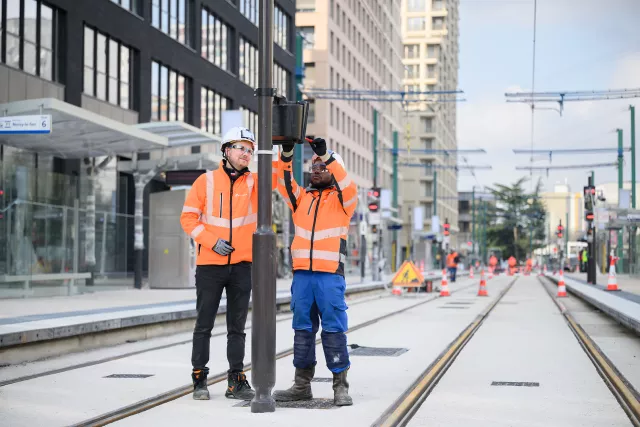
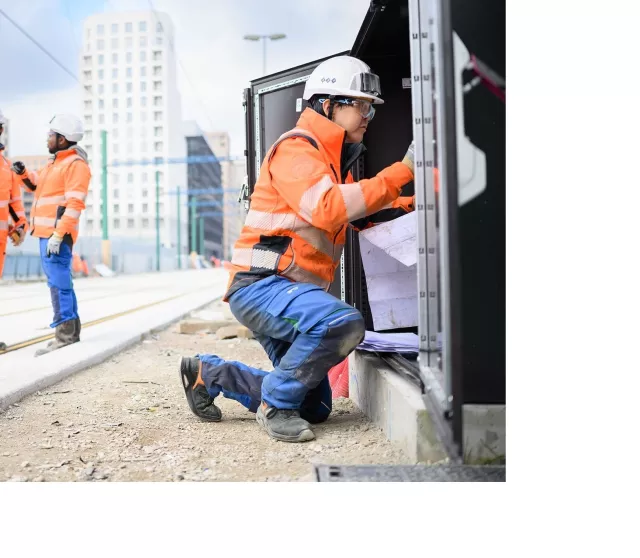
For example, Bouygues Energies & Services Urban and Road Transport, an Equans France entity, is involved in several transportation projects in the MGP region, including the T9 for the Traction, Centralized Technical Management (CTM) and Audio-Video Telecom (AVT) lots, as well as the T4, T12, and T13 Tramways for the HVLV and Traction lots. The CTM is a system that allows for the supervision and control of CFa equipment (including video, public address, intercom, traction energy management, etc.).
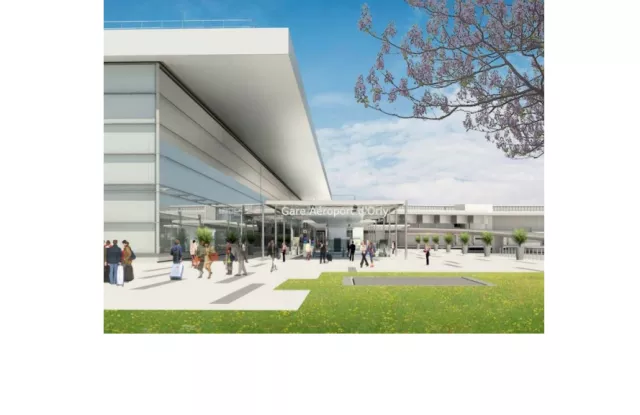
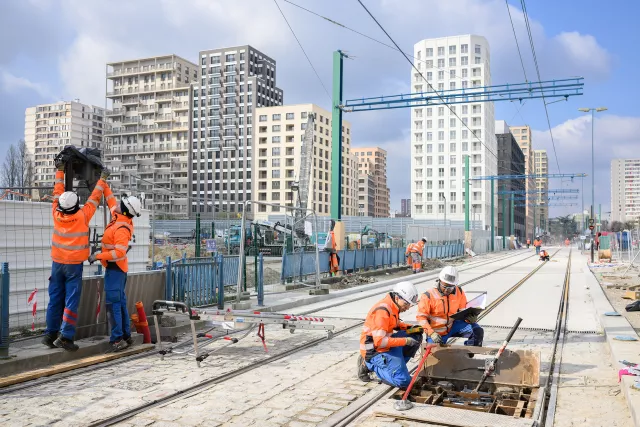
The work on the T9 Paris-Orly Ville line and its maintenance and storage site involved in particular the implementation of multi-service network systems, centralized technical management, telephony, intercom, timing, operational video surveillance, and sound systems.
Bouygues Energies & Services External Infrastructures, a subsidiary of Equans France, has been involved in several transportation projects in the Grand Paris metropolitan area, such as the Tzen 4 and the T9 and T12 Tramways, involving the partial installation of the Traffic Light Signaling (TLS).
This equipment is a key element for regulating traffic flow, managing intersections, coordinating traffic around the areas served by these tram lines, and ensuring travel safety in urban areas. Unlike previous projects, Bouygues Energies & Services carried out the complete installation of street lighting and TLS for the recently commissioned T10 line.
Street lighting plays a vital role in user safety, particularly in pedestrian and busy areas. Finally, Bouygues Energies & Services partially installed the temporary street lighting for the T7 Tram, ensuring safety and visibility in the affected areas until the completion of the final works.
Eole: Focus on an ambitious project!

The Eole project, one of the largest projects in Grand Paris, aims to extend RER Line E by 55 km westward, connecting Haussmann Saint-Lazare to Mantes-la-Jolie. This complex project involves the construction of three new stations: Porte Maillot, La Défense, and Nanterre.
This is where Bouygues Energies & Services Ferroviaire, a subsidiary of Equans France, comes in on behalf of SNCF Réseau. The company plays a key role in the installation and management of technical infrastructure.
It is involved in the implementation of the signaling systems needed to regulate train traffic on the new section of Line E, the installation of video surveillance in stations, and the civil engineering work required to integrate new infrastructure such as tunnels and stations: this work is crucial for adapting existing networks and building new extensions.
Bouygues Energies & Services is also installing communication systems that enable real-time information management between trains and control centers, facilitating the supervision and coordination of rail operations. The company is also responsible for the supply and management of electrical energy for the EOLE project.
This includes the installation of power supply systems for trains and rail infrastructure, as well as the optimization of power distribution to ensure network reliability and sustainability.
This work guarantees the regularity, energy efficiency, and durability of the future EOLE network facilities.
Elinvest or the acceleration of the deployment of charging stations for electric vehicles in France
Elinvest is an investment structure created in September 2024 by Banque des Territoires, TIIC, and Equans, with the aim of accelerating the deployment of electric vehicle charging stations in France.
Capitalized at €40 million, Elinvest aims to support local authorities and energy unions in the implementation of public charging infrastructure. Equans, thanks to its technical expertise, will ensure the design, installation, operation, and maintenance of the stations (a mix of standard, fast, and ultra-fast charging).
Elinvest targets local authorities and public parking managers and will contribute to the decarbonization of transport, which accounts for 22% of CO2 emissions in France, to achieve the goal of carbon neutrality by 2050.
Equans France currently operates nearly 15,000 charging points in France.

Real estate, an unexpected ally for more sustainable mobility
Les Lumières Pleyel - Aire Nouvelle, a subsidiary of Equans France, is committed to sustainable real estate projects that support soft mobility, such as the Lumières Pleyel project, winner of the first edition of Inventons la Métropole du Grand Paris (IMGP).
This mixed-use development, directly connected to the new Pleyel station of the Grand Paris Express, consists of eight buildings ranging from 12 to 17 floors, comprising coworking spaces, housing, and services (retail and daycare), thus reducing car dependency and promoting sustainable mobility.
Considered one of the most emblematic projects of Greater Paris due to its location, design, and scale, the "Les Lumières Pleyel" district will become the second busiest hub in the Île-de-France region, with four new metro lines (14, 15, 16, and 17) and interconnections with line 13 and the RER D.


The Cathedrals of Rail in Saint Denis – This mixed-use redevelopment project for a brownfield SNCF site located in the La Plaine district also confirms the City of Saint Denis's commitment to the high-profile Grand Paris Express project.
It includes detailed work on mobility, with a focus on reconnecting road networks and reopening the site to the neighborhood through redesigned and expanded pathways for soft modes of transport, the creation of bicycle stations, electric charging stations, and, more specifically, the establishment of a 160-space mobility center that will pool parking needs and services.
This mobility center will house a soft mobility facility that will allow local residents to securely park their bicycles of all types (electric, cargo, tricycles, etc.).