
Expert in special risks and automatic fire extinguishing
Expert in special risks and automatic fire extinguishing

Axima Sécurité Incendie's special riskexpertise is focused on protecting industrial sites with specific risks that cannot be protected by sprinkler alone.
Certain sites, such as logistics warehouses, household waste incineration plants, areas containing batteries or recharging stations, and certain industries producing or storing specific hazardous products, require protection tailored to their special risks.
True experts in their field, our dedicated department for customers with special risks works with you to implement the extinguishing solutions best suited to your challenges.
Our specialized design office, 100% dedicated to special risks, offers a tailor-made solution. Our teams are involved from analysis to recommendations, from design to installation, and then maintain the fire safety systems installed.
Our automatic fire extinguishing solutions
Water mist: a high-performance automatic extinguishing system for special hazards
Application: hotels, parking lots, machine protection, industry with transformers/generators, data centers, archive rooms, electrical rooms, industrial fryer protection etc.
The choice of water mist system depends on the risks to be protected. There are two main technologies adapted to special risks: low-pressure water mist and high-pressure water mist.
- Low-pressure water mist (LPWM ): This system operates with a working pressure of less than 12.5 bar at the nozzle (NFPA 750 standard). This system is similar to sprinkler systems in terms of design and construction. Installation is facilitated by the possibility of direct connection to the mains water supply in certain cases, offering an economical and reliable solution for tertiary buildings or industrial warehouses.
- High-pressure water mist (HPWM ): Using pressures in excess of 35 bar (reaching 60 to 120 bar). This is the preferred solution for complex volumes, high-rise buildings, archive centers or machine rooms. This technology uses stainless steel piping, and is smaller in size than the sprinkler.
Our Axima Sécurité Incendie experts can help you design these systems in accordance with APSAD R2, EN 14972-1, FM 2-81 and NFPA 750standards , and determine the optimum technology for the risk to be protected, to guarantee maximum extinguishing efficiency with reduced water consumption.
Fire safety systems using automatic foam extinguishers
Application: Petrochemical plants, warehouses, incineration plants, etc.
How does it work?
Depending on the environment, there are 3 solutions: low-, medium- and high-expansion fire-fighting foam
The equipment used to produce foam includes generators, weirs, nozzles or cannons. The mixture of water and additive (chosen and dosed according to risk) creates a foam carpet (thanks to expansion), isolating the combustible part from the oxidizing part.
Low" and "medium" expansion extinguishing foam is mainly used for fires involving sheets of flammable liquids (hydrocarbons, alcohol, etc.). High-expansion foams are recommended for specific fire protection of storage premises. Fire-fighting systems using high-expansion foam can fill a room beyond storage height in less than 3 minutes!
Extinguishing gases: operation and types of IEAG solutions
Application: Datacenters, electrical rooms, archives and sensitive technical rooms where water could damage equipment.
How does it work?
An Automatic Gas Extinguishing System (AGES) works on three principles: smothering by reducing oxygen levels, inhibiting chemical combustion reactions, or rapidly cooling the fire. Two families of extinguishing gases can be distinguished: inert gases (nitrogen, argon, IG-55 mixtures), which dilute oxygen to 12-15%, and Co2. Inhibitor gases (FK-5-1-12) stop the combustion reaction at low concentrations. The latter are subject to various environmental regulations limiting their use.
The system is triggered by double automatic detection or manual control, distributing the extinguishing agent via a network of nozzles within a few seconds. This residue-free technology preserves your electronic equipment while effectively extinguishing Class A, B and C fires.
Automatic fire detection system
Fire detection provides the fastest possible warning of the risk, so that the appropriate emergency resources can be deployed.
Axima Sécurité Incendie designs and installs fire detection systems, including :
- Automatic smoke, heat and flame detectors, particle analysis, linear detectors, etc.
- Thermographic cameras for immediate identification of heat sources
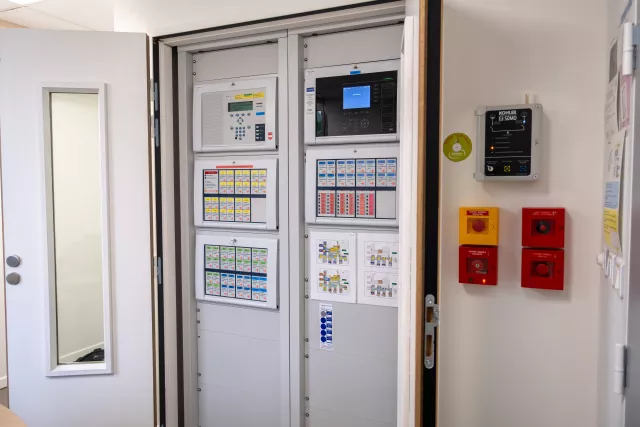
These systems are complemented by manual alarm triggers. All this equipment transmits information to a control center (S.D.I.), depending on the size of the installation. These control units can be conventional or addressable*.
Alarm and evacuation systems
Alarm and evacuation systems are mandatory (FrenchLabor Code) if the number of people in the facility exceeds 20 , or if the activities are high-risk (e.g. SEVESO-type sites). They are also mandatory for establishments open to the public (E .R.P.).
Fixed gas detection: a fire safety and industrial surveillance system
Application: Industrial boiler rooms, process rooms, parking lots, forklift loading areas
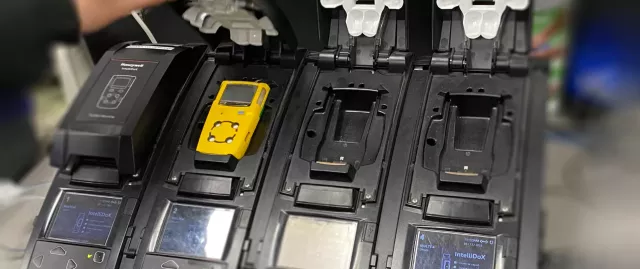
Gas detection is essentially used to detect gas leaksat burner supply points, control a gas shut-off valve and sound the alarm.
Gas detection is used to detect the slightest leak that could jeopardize the safety of people and industrial facilities: food processing, petrochemicals, pharmaceuticals, chemicals, etc.
Parking lots: it detects carbon monoxide pollution and, depending on the concentration, activates powerful extraction fans.
Fixed gas detection is an essential element of protection and safeguard.
The system comprises a single- or multi-channelcontrol unit, sensors or suction systems.

Maintenance and certification of your fire safety systems
Extinguishing gases
Maintenance The preventive maintenance of your automatic gas extinguishing systems is based on rigorous checks on the tanks and the charge of extinguishing agents (inert or inhibiting gases). Our technicians check the entire installation and ensure that the protected enclosure is perfectly watertight by means of infiltrometry tests. These periodic interventions ensure that your system is ready to release the extinguishing agent instantly in the event of detection, while avoiding untimely triggering.
Certification and regulations Our services scrupulously comply with the APSAD R13 standard for automatic gas extinguishing systems, as well as ISO 14520-1 and NF EN 15004 standards. We also comply with the requirements for ten-year requalification (DESP) in accordance with current regulations. As an expert, Axima Sécurité Incendie issues you with N13 certificates of conformity, essential for your insurers and for compliance with the French Labor Code.
Mosses
Maintenance Foam system maintenance includes annual analysis of foam quality to check foaming properties and correct foam concentration (low, medium or high expansion). We inspect generators, cannons and weirs to prevent clogging, and test dosing systems to ensure accurate water/additive mixing. We can also help you make the transition to PFAS-free solutions, and advise you on methods for decontaminating networks and replacing old fluorinated emulsifiers.
Certification and regulations Foam protection systems are governed by APSAD R12, NFPA 11, FM 8-21 and NF EN 13565-2 standards. Our experts ensure that your flammable liquid storage systems or logistics warehouses meet the requirements of the ministerial decree of October 4, 2010, as well as the latest regulatory updates.
Water mist
Maintenance To guarantee the efficiency of low- or high-pressure water misting, we carry out flow tests and check the cleanliness of nozzles. Maintenance includes checking the pumping units and the various triggering stations, as well as inspecting the piping networks to avoid any risk of corrosion or scale build-up.
Certification and regulations Our water mist solutions are designed and maintained in compliance with APSAD R2 (October 2023 edition), NFPA 750 and European standard EN 14972-1. The conformity of the completed installation is validated by DIOM-compliant reports (Dossier d'Identité de l'Ouvrage de Maintenance). This regulatory rigor is essential for the protection of your sites, whether data centers, hotels or sensitive industrial structures.
Fire detection
Maintenance Maintenance of your Fire Detection System (FDS) includes individual testing of each detector (smoke, heat, flame) and checking communication with the addressable or conventional control panel. We clean the detector heads and replace the back-up batteries as a preventive measure. This constant monitoring eliminates grey areas and ensures early warning, essential for activating automatic extinguishing devices.
Certification and regulations We operate within the strict framework of APSAD R7 certification, a major reference for automatic fire detection. Our installations comply with the NF EN 54 series of standards, guaranteeing equipment interoperability. At the end of our inspections, we issue you with a Q7 certificate of conformity, certifying that your fire safety system (SSI) complies with safety requirements for people and property.
Alarm and evacuation systems
Maintenance Maintenance of alarm equipment includes testing the audibility of sirens at all points in the building, and the visibility of light displays. We check that manual triggers are working properly, and that actuated safety devices such as fire doors and smoke extraction dampers are properly controlled. These regular checks ensure that, as soon as a disaster is detected, the evacuation order is transmitted without fail to all occupants.
Certification and regulations Alarm and evacuation systems must comply with APSAD installation rules and standards NF S 61-931 to NF S 61-933. Compliance with these standards is a legal obligation under French labor law and ERP (Établissements Recevant du Public) regulations. Our experts ensure that your equipment remains compliant and in good working order, and advise you on how to keep your installation up to date.
Contact our experts for a personalized audit of your maintenance and compliance contracts.


Our other fire safety solutions


Frequently asked questions about automatic fire extinguishing systems
How does automatic shutdown work?
Automatic extinguishing is triggered as soon as a detector detects rising heat or smoke. The extinguishing agent (water, gas or foam) is automatically applied to the area concerned, without human intervention.
What are the 4 methods of extinguishing a fire?
The four extinguishing methods are cooling (lowering the temperature), smothering (oxygen deprivation), inhibition (stopping the chemical reaction) and isolation (separating the fuel).
How much does a sprinkler system cost?
The price varies according to the type of system, the surface area to be protected and the level of risk. Contact our experts for a personalized quote tailored to your environment.
What types of extinguishing systems are suitable for special hazards and data centers?
For sensitive environments such as data centers or complex industrial sites, we recommend sprinkler, gas (inert or CO2) or water mist automatic extinguishing solutions. These technologies make it possible to contain or extinguish the fire while preserving the integrity of critical electronic equipment. Our experts design tailor-made installations that comply with current standards and regulations to guarantee optimum business continuity.
What are the regulatory requirements for the maintenance of fire safety systems?
Regulations require rigorous periodic checks to guarantee system reliability. Preventive maintenance is mandatory, in accordance with regulatory standards such as EN 12 845 (sprinkler systems), EN 14 972-1 (water mist systems) and EN 15004-1 (gas systems), as well as more in-depth inspections. Axima Sécurité Incendie supports you with customized maintenance contracts.
How does theSprinkBox®solution optimize my fire safety management?
SprinkBox® is a connected supervision solution that enables real-time monitoring of your security installations. It dematerializes your paper-based logging and instantly alerts you by SMS or email in the event of an anomaly or alarm triggering. This innovation reduces your maintenance costs while offering complete traceability of your equipment, accessible 24/7 via a secure web interface.
Why is it urgent to switch to PFAS-free foam additives for my foam extinguishing systems?
Regulatory developments call for a gradual ban on fluorinated emulsifiers (PFAS) by 2030, due to their environmental impact. Anticipating this transition is crucial to staying in compliance. We offer comprehensive support, including an engineering study and the necessary modifications to your installation to ensure the migration of your emulsifier to a high-performance non-fluorinated emulsifier, guaranteeing effective protection of your flammable liquid stocks.
What is the advantage of the SprinkEco solution for outdoor networks?
The SprinkEco solution keeps your sprinkler networks frost-free without using polluting antifreeze. By circulating water heated to a low temperature (5°C) via heat recovery or a dedicated boiler room, you can ensure that your system is available even in the coldest weather. It's an ecological and economical alternative that extends the life of your installations while meeting thermal performance requirements.


Do you have a need? Let's talk about it!
Do you have a need? Let's talk about it!
