

Sprinklers: Your Automatic Fire Suppression Solutions
Sprinklers: Your Automatic Fire Suppression Solutions
Sprinklers remain the most reliable system for controlling fires. According to insurance industry statistics, 95% of fires are brought under control by this automatic fire suppression system.
Axima Sécurité Incendie, a division of Equans France, has been helping you protect your property and people for over 40 years.
We offer innovative solutions: connected monitoring, eco-friendly freeze protection, water conservation and thirty-year inspection in compliance with APSAD standards.
What is a sprinkler system, and how does it work?
Definition and Principles of Sprinkling
A sprinkler system is an automatic water-based fire suppression system. It protects your property and people without human intervention. The system is triggered automatically by the rise in temperature caused by a fire: each sprinkler head contains a heat-sensitive bulb that activates independently as needed. It shatters when the temperature reaches a preset threshold. Only the sprinkler heads exposed to heat are activated, allowing for precise water application to the affected area.
Several systems are available depending on your specific requirements. The wet system, which maintains continuous water pressure in the pipes. The air-pressurized system, which maintains air pressure in the pipes and is used when the pipes are at risk of freezing.
The deluge system, which activates all sprinkler heads simultaneously. It is used when the risk of fire is very high and the fire spreads extremely rapidly. The pre-action system is used when it is absolutely necessary to minimize the risk of accidental activation; it features a two-stage activation process. It is generally used to protect sensitive equipment.

The components of a sprinkler system: piping, pump, control panel, tank, and alarms
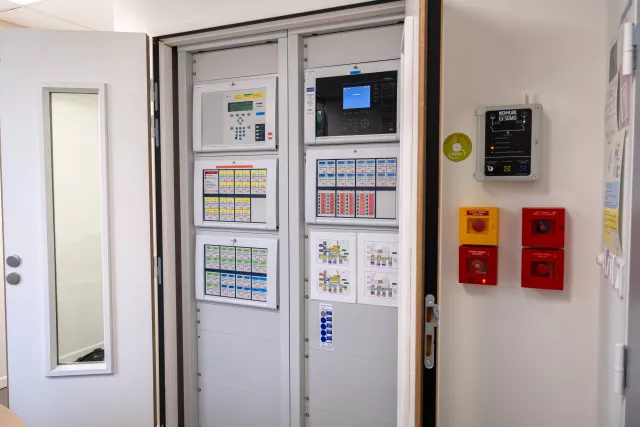
Your sprinkler system consists of five main components that ensure its effectiveness when properly maintained.
The sprinkler head is the visible component. It contains the heat-sensitive bulb and the water diffuser. It is mounted on the pipe network that carries water to the heads. It is generally made of galvanized steel but can also be made of stainless steel. The control panel monitors pressure, triggers the alarm, and regulates the water flow to the piping system. The tank or reservoir stores the water supply needed for fire suppression and feeds the piping network. The pumping unit or water source distributes water throughout the network. There may be up to two separate water sources (A and B), depending on requirements.
The table below compares the main types of sprinkler systems:
HOW IT WORKS
TYPICAL APPLICATION
Constant water pressure in the pipes
Heated buildings, industry, logistics
HOW IT WORKS
TYPICAL APPLICATION
Compressed air in the system, water ingress in less than 60 seconds
Areas exposed to freezing temperatures, cold storage rooms, loading docks
HOW IT WORKS
TYPICAL APPLICATION
Simultaneous activation of all heads
Special hazards, petrochemicals, ATEX zones
HOW IT WORKS
TYPICAL APPLICATION
Two-stage triggering with preliminary detection
Data centers, server rooms, archives
Sprinkler Regulations and Installation in France
Automatic Shutdown: Applicable Standards and Certifications
Axima Sécurité Incendie designs and installs your sprinkler systems in accordance with several recognized standards. The APSAD R1 standard serves as the French reference framework for issuing an N1 certificate of compliance, valid for 30 years.
Depending on your needs and your insurer’s requirements, we also install systems in accordance with the NF EN 12845 standard, FM Global, and NFPA.
Our Innovative Sprinkler Solutions for Your Business
Equans provides long-term support for fire safety at your facilities through recognized expertise and a strong commitment to innovation. We design and deploy a comprehensive range of innovative sprinkler solutions, tailored to precisely address your challenges in performance, business continuity, and regulatory compliance.
Axima Sécurité Incendie is currently the only installer to offer exclusive solutions such as SprinkBox® or SprinkEco. These next-generation sprinkler solutions combine system reliability, advanced connectivity, environmental performance, and strict compliance with current standards. They incorporate the latest innovations in connected monitoring, system control, and freeze protection, for ever-more-reliable fire safety.
Thanks to these innovative sprinkler solutions, you have real-time access to key data from your fire protection equipment. Connected sensors continuously monitor pressure, temperature, and pump operation, ensuring precise and reliable monitoring of your sprinkler systems.
Implementing these connected technologies helps significantly reduce maintenance costs, improve system availability, and anticipate incidents. In the event of a malfunction, automatic notifications alert you immediately, ensuring maximum responsiveness and enhanced fire safety.
MAIN BENEFIT
TYPICAL USE CASES
Glycol-free freeze protection with low-temperature heated water circulation
Unheated buildings, awnings, loading docks
MAIN BENEFIT
TYPICAL USE CASES
24/7 remote monitoring, removal of manometer traces, and automatic alerts in case of a problem
All sites with sprinkler systems, with or without an Axima Sécurité Incendie maintenance contract
MAIN BENEFIT
TYPICAL USE CASES
Save up to 390 m³ of water per year
All sites equipped with a sprinkler system
SprinkBox®: Connected Monitoring for Your Sprinkler System
SprinkBox® is a connected sprinkler monitoring solution that centralizes real-time monitoring of your system. Using smart sensors and probes, it instantly detects anomalies, sends alerts via text message or email, and automates the digitization of your readings and maintenance reports. This provides you with simple, continuous, and secure management of your sprinkler system.
The SprinkBox® Monitoring solution transforms your technical data into valuable decision-making tools. It automatically generates weekly PDF reports to replace the paper tape charts from control stations, as well as a detailed annual N-1 report, ensuring complete traceability of your system. You can precisely track your equipment’s operating times, the number of pump starts, and recurring alarms. This connected sprinkler monitoring system, fully integrated into an Industry 4.0 framework, improves your responsiveness, enhances the reliability of your operations, and simplifies the regulatory and operational management of your equipment in the long term.
SprinkEco: The Alternative for Frost Protection
The risk of freezing threatens the effectiveness of your sprinkler systems. SprinkEco offers an eco-friendly solution to avoid the use of glycol.
With this solution, low-temperature heated water circulates only when necessary in areas at risk of freezing. It eliminates the need to insulate or heat the entire building to protect the sprinkler systems from freezing.
The water circulates in a closed loop at around 5°C via a heat exchanger. This approach reduces your energy consumption and CO2 emissions. SprinkEco is particularly well-suited for large-volume facilities that do not need to insulate or heat their buildings.
Water Conservation: Preserving the Resources of Your Sprinkler System
Your weekly tests of diesel motor-pump units consume up to 390 m³ of drinking water per year. With a buffer tank, a lift pump, and a three-way valve, you can operate in a closed-loop system to recover the water used to cool the motor-pump unit. This water is then reinjected directly into your sprinkler tank. This solution is a simple way to conserve your potable water resources.
Cleaning your tanks with divers or robots also allows you to make water savings by avoiding the need to drain your tank. You save tens of thousands of cubic meters. You reduce your system’s downtime to just 4 to 8 hours. These solutions comply with CNPP requirements and the APSAD R1 standard.




Frequently Asked Questions About Sprinklers
What is the difference between a sprinkler and a fire hose reel?
A sprinkler is an automatic fire suppression system. It activates without human intervention as soon as it detects the heat from a fire. A fire hydrant is a manual first-response device. It requires manual operation to be used. The two solutions work together to contain the fire until emergency responders arrive.
What Is Sprinkler Risk?
Sprinkler risk refers to the level of risk covered by your sprinkler system. It is classified based on the activities and stored materials at your site. This classification determines the system’s design. It defines the number of sprinkler heads needed and the required water density. Industrial facilities, shopping centers, and warehouses each present different sprinkler risks. Each requires tailored protection.
How many sprinkler heads are needed per square meter?
There is no single number of sprinkler heads per square meter: it all depends on the fire risk classification and the applicable standards (APSAD R1 / NF EN 12845 / FM Global / NFPA). The maximum area protected by a single sprinkler head can range from 20 m² to 6 m². The higher the risk, the greater the sprinkler density. The correct criterion is never square meters alone, but rather the fire risk, ceiling height, obstacles, and the nature of the stored materials.
How many sprinkler heads per control station?
The number of heads per control station depends on the overall system design and the applicable standards. According to the APSAD R1 standard, a system may have up to 1,000 heads per control station. This number varies depending on the protected area, the risk level, and the required activation temperature. Each project undergoes a specific analysis to ensure compliance.
How much does a sprinkler system cost?
The price depends on several factors: the area to be protected, the risk level, the type of system (water-based, air-based, deluge), and the applicable standards (APSAD R1, FM Global, NFPA, NF EN 12845). Each project requires a customized study to assess system requirements, including the sizing of the water tank(s) and control stations. The cost of a sprinkler system is a powerful insurance lever, offering a significant reduction in the risk of business interruption and, in some cases, a prerequisite for the site’s operational viability. Contact our Equans experts for a quote tailored to your environment and regulatory requirements.




Do you have a need? Let's talk about it!
Do you have a need? Let's talk about it!