

Prepare Your Buildings for Extreme Heat Today
Improve comfort during the summer, protect your critical equipment, and ensure business continuity.Prepare Your Buildings for Extreme Heat Today
Improve comfort during the summer, protect your critical equipment, and ensure business continuity.
Heat waves are becoming more frequent, longer, and more intense. For owners, operators, and managers of commercial, industrial, or data center buildings, the challenge is no longer limited to occupant comfort. It also involves protecting critical equipment, preventing operational disruptions, and ensuring the long-term performance of real estate assets.
In light of these risks, Equans supports its clients from identifying vulnerabilities through to implementing and maintaining adaptation solutions. Our approach combines auditing, operations and maintenance, engineering, energy, digital technology, HVAC, and cooling solutions.
Is your building ready for the next heat waves?
Why should we take action now in response to the heat wave?
A heat wave can reveal or exacerbate vulnerabilities in buildings and technical systems that are not adapted to climate change:
- reduced summer comfort for occupants;
- increased strain on HVAC and electrical systems;
- equipment failure or overloading of the cooling system;
- increased energy consumption;
- increased maintenance and operating costs;
- the need to operate in degraded mode;
- interruption of a production line or critical service;
- a decline in the value and appeal of the real estate portfolio.
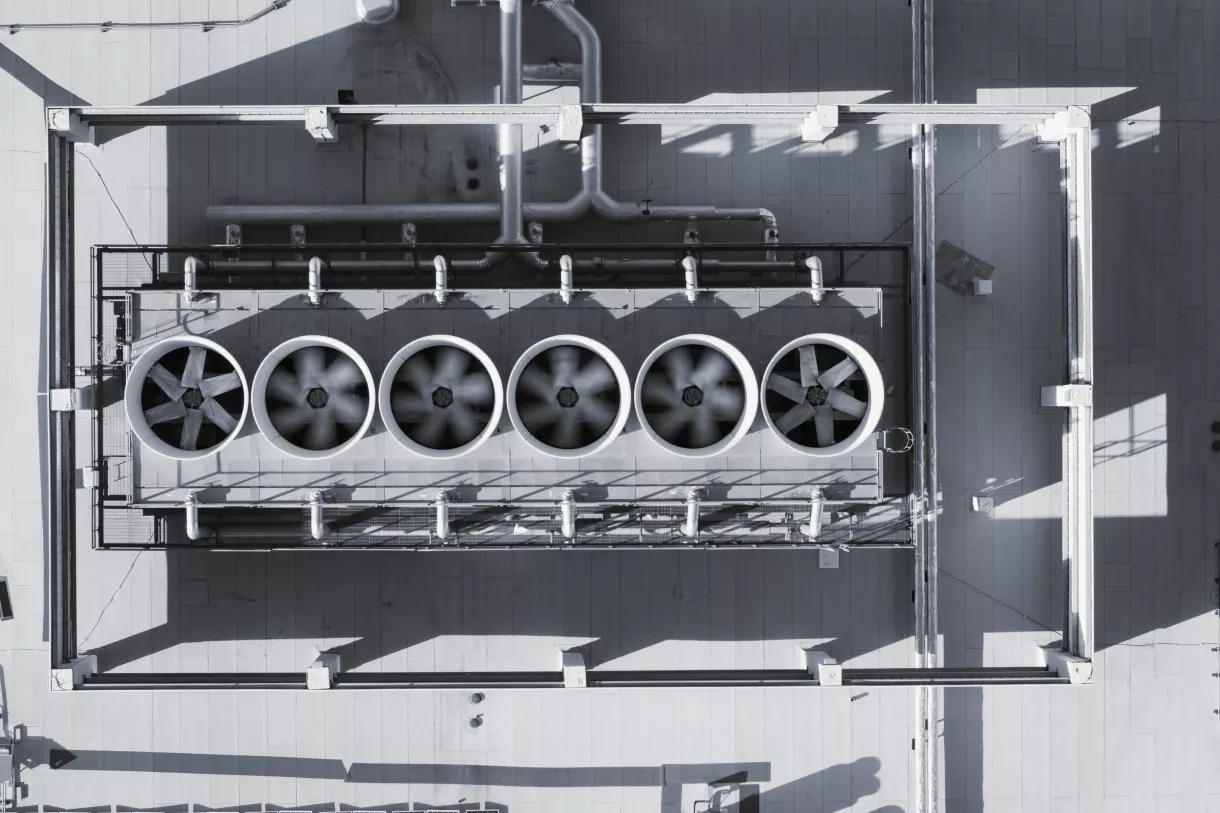
Healthcare facilities, nursing homes, schools, offices, commercial buildings, industrial sites, and data centers each present different challenges. Nevertheless, they share a common goal: to maintain appropriate operating conditions, even during periods of extreme heat.
Prepare for the impact of future heat waves on your buildings and facilities
Given the need to adapt your buildings to extreme heat, plan ahead with Equans
The summer of 2026 revealed the increasing frequency of heat waves, their unpredictability, and the limitations of many buildings in the face of climate-related risks. Deteriorating comfort, overheated spaces, and emergency responses have highlighted the need to adapt the building stock now to strengthen its climate resilience.
There is no one-size-fits-all solution for improving summer comfort and enhancing a building’s climate resilience. The solution must take into account the building’s exposure, envelope, systems, uses, the sensitivity of its occupants, and the criticality of the activities housed within it.

“ Equans’ approach involves identifying and implementing the solution best suited to the challenges faced by your buildings and their occupants, while balancing climate resilience, energy efficiency, and decarbonization. ”

PLAN AHEAD TO AVOID PROBLEMS
- Vulnerability Audit and Roadmap
- Equipment Maintenance Before the Summer Season

PROTECT AGAINST SUNLIGHT
- Sun protection
- Roof and Facade Insulation / Reflective Coatings
- Green Roofs
- Building Management System (BMS) Control

VENTILATE NATURALLY
- Air circulators
- Natural ventilation / Nighttime over-ventilation

REFRESH SMARTLY
- Cooling and Adiabatic Drying
- CTA with cooling coil
- Terminal induction
- Geothermal energy / Geocooling

USE AIR CONDITIONING ONLY WHEN NECESSARY
- Split systems / DRV / VRV
- Chiller and Reversible Heat Pump
- Redundancy solutions including mobile chillers
Strategies for Climate Resilience Against Heat in Buildings
Plan Ahead to Avoid the Heat
During a heat wave, refrigeration, ventilation, and air conditioning systems are under heavy strain. Their availability becomes critical to ensuring occupant comfort, the continuity of industrial processes, or the operation of critical infrastructure.
The first step is to improve the reliability and optimize existing facilities:
- raising awareness among teams and adjusting management;
- maintenance of the cooling system;
- cleaning scale from the systems;
- adjustment of operating setpoints;
- analysis of operation under degraded load conditions;
- assessment of equipment criticality and redundancy;
- preparation of a temporary feed-in for a rental solution;
- Implementation of a business continuity plan.
The operations and maintenance teams are performing preventive maintenance on technical systems in preparation for the summer season. Thanks to their knowledge of the buildings and equipment, they can identify vulnerabilities more quickly, anticipate risks, and take action in the event of adverse weather conditions.
Protecting the building from solar radiation
Reducing solar gain is a key strategy for limiting overheating and reducing cooling needs.
Depending on the building's layout, several solutions can be considered:
- fixed or retractable awnings and sunshades;
- manual, motorized, or automated sun protection systems;
- solar control glazing;
- solar control films on windows;
- wall and roof insulation;
- reflective coatings or suitable paints;
- green roofs;
- control of protective measures via the building management system (BMS) or the technical building management system (TBMS).
Solutions are selected based on the building’s orientation, its structural characteristics, its uses, and its energy performance goals.
Reduce heat input before generating more cooling
Automate sun protection systems and adjust their operation based on actual conditions
Ventilate to Naturally Improve Summer Comfort
When outdoor conditions permit, ventilation can help remove heat that has built up inside the building and improve perceived comfort.
Possible solutions include:
- air circulators;
- automated window and door systems;
- natural ventilation;
- nighttime overventilation;
- adjustment of operating schedules and scenarios;
- coordinated control of ventilation and solar shading.
These solutions must be evaluated taking into account air quality, safety, noise levels, outdoor conditions, and operational constraints.
Improve air circulation and thermal comfort in your spaces
Smart Cooling
When passive solutions are not enough, cooling systems can supplement the setup while limiting the use of traditional air conditioning.
Equans can, in particular, analyze:
- adiabatic cooling;
- adiabatic drying;
- air handling units equipped with a cooling coil;
- terminal induction;
- optimization or retrofitting of an existing air handling unit;
- geocooling
Adiabatic cooling uses water evaporation to lower the air temperature. It can be integrated into an air handling unit to treat exhaust air, supply air, or fresh air, depending on the chosen configuration.
This solution can offer several advantages:
- low power consumption;
- no compressor or refrigeration circuit in the adiabatic chamber;
- no refrigerant gas used in the process;
- simplified maintenance;
- Can be adapted for commercial buildings, public access buildings, schools, gymnasiums, multipurpose halls, nursing homes, non-air-conditioned offices, and certain industrial environments.
The adiabatic dry cooler combines a dry air cooler with an adiabatic pre-cooling section. Water evaporation lowers the temperature of the ambient air before it enters the equipment, thereby enhancing its cooling capacity as outdoor temperatures rise.
This solution is particularly well-suited to meet the needs of data centers, industrial sites, and building HVAC systems.
Find the cooling solution that's right for your building and its uses
Use air conditioning when active cooling is essential
In certain buildings, in sensitive areas, or for critical processes, active cooling remains necessary to maintain a temperature suitable for the intended use.
Solutions may include, among other things:
- single-split or multi-split systems;
- DRV or VRF systems;
- chilled water production units;
- reversible heat pumps;
- associated terminal emitters;
- geothermal energy;
- geocooling
System sizing must be based on actual needs, reference climate conditions, criticality level, installation constraints, and energy efficiency goals.
Single-split and multi-split systems allow for the climate control of one or more rooms using an outdoor unit connected to one or more indoor units. They can address localized needs and enable individualized space management.
Variable refrigerant flow systems can heat or cool multiple zones from a single outdoor unit. Control settings can be tailored to each zone, and certain configurations allow for energy recovery.
A reversible heat pump can provide heating in the winter and cooling in the summer. Depending on its design, it can also utilize recovered heat and simultaneously produce both heat and cooling.
Design, modernize, or improve the reliability of your refrigeration system
In the event of a breakdown, scheduled maintenance, or seasonal demand, a portable chiller can be deployed to provide additional capacity. This temporary and scalable solution helps maintain operations during exceptional circumstances.
Temporary cooling

Assess the building's vulnerability to take more effective action
A vulnerability audit simulates or analyzes the thermal behavior of a building and its systems; in particular, it identifies points of vulnerability and assesses risks during a heat wave.
It aims to propose a tailored roadmap.
Equans offers a multi-risk approach (heat waves, fires, floods, storms, water stress, and drought) or a targeted approach focused on summer comfort, for example.
These studies may involve commercial buildings, industrial sites, data centers, and critical facilities.
Identify vulnerabilities in your facilities and develop an action plan before the next heat wave
Solutions tailored to each type of building

Offices and Commercial Buildings
In commercial buildings, heat waves can affect employee comfort, equipment operation, and the attractiveness of the property. The approach may combine solar shading, ventilation, building management systems, system optimization, cooling, and targeted air conditioning.

Healthcare Facilities and Nursing Homes
In healthcare facilities and nursing homes, measures to adapt to extreme heat must take into account vulnerable residents, staff working conditions, and the continuity of critical systems.

Elementary, middle, and high schools
Schools must be able to maintain appropriate conditions for students’ comfort and learning during periods of extreme heat. Solutions may include a combination of sunshades, natural or nighttime ventilation, air circulators, and appropriate cooling measures.

Industry and Critical Infrastructure
In industry, heat can put a strain on refrigeration systems, disrupt processes, and increase the risk of operational downtime. Criticality analysis, redundancy, emergency solutions, and increased cooling capacity can help ensure production continuity.

Data Centers
For data centers, uninterrupted cooling is essential to infrastructure availability. A study may focus, in particular, on the performance of facilities under extreme conditions, redundancy, degraded operation, and backup systems.
FAQ: Buildings, Extreme Heat, and Heat Waves
How can you protect a building from extreme heat?
An effective strategy involves first reducing solar heat gain, then removing accumulated heat, and optimizing existing systems. Solar shading, insulation, ventilation, building management systems (BMS), adiabatic cooling, and refrigeration can be combined depending on the building’s constraints.
An audit allows these solutions to be prioritized based on their effectiveness, cost, implementation timeline, and contribution to business continuity.
How can summer comfort be improved in a commercial building?
Summer comfort depends on solar exposure, the building envelope, ventilation, HVAC systems, building management, and occupancy patterns. It can be improved through solar shading, nighttime ventilation, air circulators, adiabatic cooling, or targeted air conditioning.
A summer comfort study allows for the simulation of a building’s thermal performance and the comparison of possible solutions.
Is it possible to cool a building without installing air conditioning?
Yes, when the building’s characteristics and outdoor conditions allow it. Solar shading, natural ventilation, nighttime ventilation, air circulators, and adiabatic cooling can help improve comfort without immediately installing traditional air conditioning.
A preliminary analysis is still necessary to verify that these solutions can achieve the expected level of comfort or temperature
What is a heat stress vulnerability audit?
A vulnerability audit analyzes the behavior of a building and its systems under extreme weather conditions. It helps identify points of weakness, assess the risks of performance deviations, and propose corrective actions.
Depending on the needs, it can be supplemented by a verification of installed capacities, an analysis of operating procedures, a study of degraded-mode operation, or a summer comfort simulation.
How can HVAC systems be protected during a heat wave?
Preventive maintenance, refrigeration system maintenance, system flushing, and setpoint adjustment all help ensure the safety of the facilities. For sensitive sites, it is also necessary to assess equipment criticality, redundancy, and backup solutions.
A temporary inlet can be prepared to facilitate the rapid connection of a portable chiller in the event of a failure or exceptional need.
What is a portable chiller used for?
A portable chiller provides temporary supplemental cooling capacity. It can be used during a power outage, a maintenance operation, a peak in activity, or an exceptional heat wave.
Its rapid startup and scalable capacity help minimize the risk of operational disruptions.
What role does the building management system play during heat waves?
Building management systems coordinate building systems and adapt their operation to actual conditions. In particular, they can control sunshades, ventilation, temperature setpoints, and operating ranges.
The goal is to improve comfort, prevent unnecessary energy consumption, and reduce the strain on equipment during peak periods.
When should you install or upgrade an air conditioning system?
Air conditioning may be necessary when other solutions cannot maintain the desired temperatures or when the building houses people, equipment, or sensitive processes.
The choice between split, multi-split, DRV, chiller, or reversible heat pump systems should be based on an assessment of the site’s needs, level of criticality, energy consumption, and constraints.
How can an industrial site be protected during a heat wave?
The process begins with an analysis of critical equipment and process cooling requirements. It must identify vulnerabilities, verify redundancy, and define operating conditions in degraded mode.
Actions may include maintaining the facilities, increasing cooling capacity, preparing a temporary solution, or installing a chiller, a reversible heat pump, or a dry adiabatic system.
How does Equans help make buildings more resilient to extreme heat?
Equans provides services ranging from risk identification to the implementation and maintenance of solutions. Our support services may include vulnerability assessments, summer comfort studies, criticality analyses, operations and maintenance, building management systems (BMS), solar shading, ventilation, adiabatic cooling, and refrigeration.
This integrated approach aims to balance summer comfort, business continuity, energy efficiency, asset resilience, and decarbonization.


Let's start preparing now for the next heat waves
Conduct a review of the recent heat waves, identify vulnerabilities in your buildings, and develop an action plan tailored to your operations.Let's start preparing now for the next heat waves
Conduct a review of the recent heat waves, identify vulnerabilities in your buildings, and develop an action plan tailored to your operations.