A Challenge in Terms of Mobility Infrastructure Performance
A Challenge in Terms of Mobility Infrastructure Performance

The Grand Paris Express project highlights the need to deploy advanced technical solutions to ensure the reliability, efficiency, and safety of new transportation networks. In this context, performance drivers—whether related to traction systems, catenary systems, or signaling systems—are central to ensuring a sustainable and optimized infrastructure.
Traction system for Lines 16 and 17
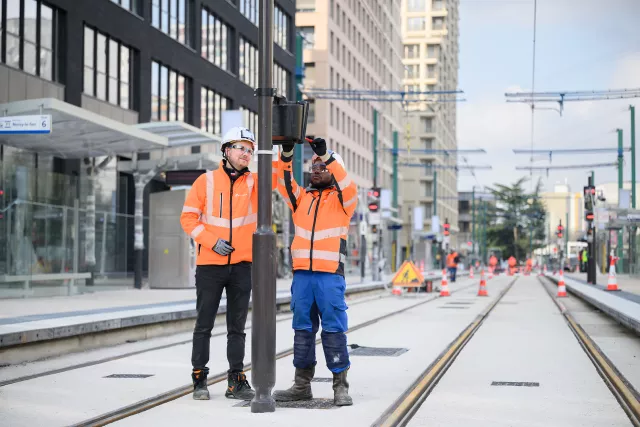
A key driver of infrastructure performance, Ineo Rail and Ineo UTS (experts in the design, construction, and integration of urban transit systems specializing in power supply, traction, signaling, and supervision) are involved in the installation and commissioning of the traction system for Lines 16 and 17.
As part of this contract, they will supply and install the traction equipment necessary to power the trains on the lines and the infrastructure maintenance vehicles housed at the Aulnay-sous-Bois operations center. All traction equipment is located in approximately thirty substations along the tracks, both at stations and in ancillary structures.
Thus, the future GPE trains will operate at an electrical voltage of 1,500 Vdc (volts direct current), which is twice the DC voltage typically used by the Paris Metro or trams (750 Vdc), perenabling subways designed to serve more distant suburbs to cover ever-longer distances between stations in ever-shorter times. The traction system refers to all the equipment and technologies used to power trains on public transit networks by providing them with the energy needed to accelerate.
Thanks to the traction system, the alternating current fourby Enedis is converted into direct current, enabling trains to operate autonomously, safely, and energy-efficiently.
The traction system is essential to the automation of the Grand Paris Express, where it ensures a reliable and continuous power supply for fast and smooth travel.
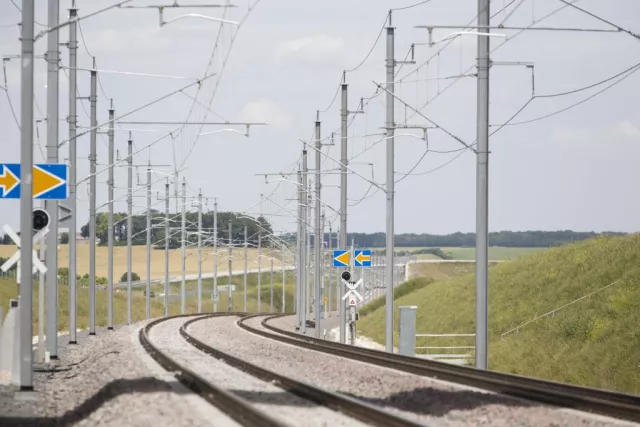
The catenary, a specialized piece of infrastructure that supplies power to electric trains.

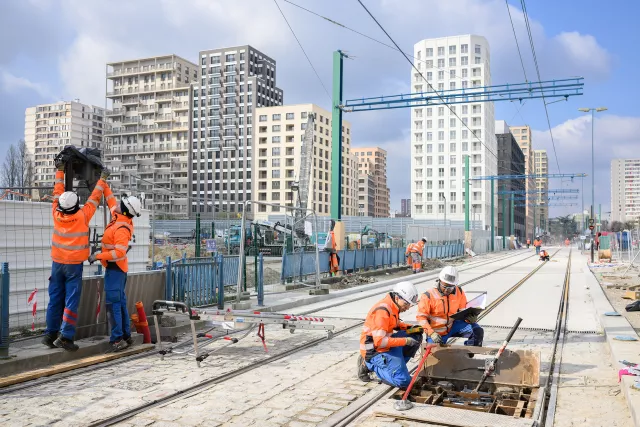
It consists of a network of overhead cables suspended above the railroad tracks, through which the necessary current—supplied by the upstream traction system—is delivered downstream to the rolling stock via a pantograph.
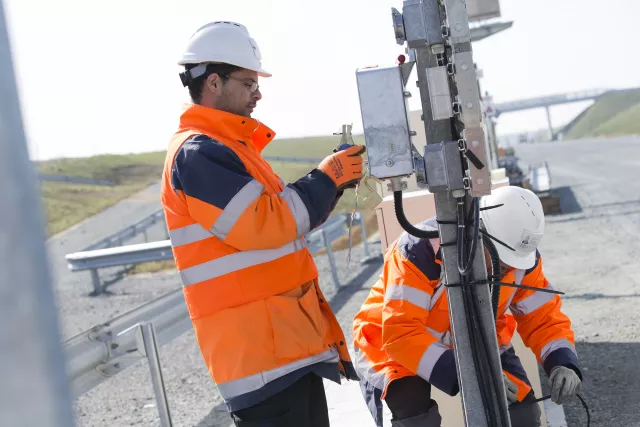
Ineo SCLE Ferroviaire, an expert in electrification and si¨gnaling for public and rail transportation, is responsible for the supply and installation of sys¨catenary systems, track-side equipment, and local signaling for the operations center for the future GPE Metro Lines 16 and 17 in Aulnay--sous-Bois.
As part of this project, Ineo SCLE Ferroviaire is also leading the consortium formed with Unifer and GCF.
One of the challenges of this project lies, among other things, in managing the wide variety of track types associated with different maintenance constraints: tracks on sleepers, embedded tracks, ballasted tracks, concrete tracks, and washing machine tracks…
Each type of track requires tailored approaches and solutions to meet specific maintenance and operational requirements.
Equans France’s expertise in carrying out complex rail projects, acting as the lead contractor, has demonstrated its ability to adapt to these diverse configurations while meeting performance requirements.
Signage, another key component of the GPE's infrastructure performance.
At the Aulnay Infrastructure Maintenance Site (SMI), this signaling system implemented by the teams at Ineo SCLE Ferroviaire makes it possible to coordinatethe movements of maintenance vehicles that will depart from the SMI to various parts of the network.
Among the GPE’s six operations centers spread across the entire 200-km network, the one in Aulnay-sous-Bois will serve as the control center for Lines 16 and 17, which are essential to the development of the eastern and northern parts of the MGP.
Real-time traffic monitoring and control, restoration of normal service in the event of an incident, technical maintenance of trains (brakes, air conditioning, interior fittings), interior and exterior cleaning of trains, and maintenance of stations, service facilities, tracks, and signaling systems: all these functions will be provided 24 hours a day, 7 days a week from the Aulnay operations center.
Still on the topic of power supply, but this time also including the energy needs of the signaling, ventilation, and lighting systems, Equans, through its subsidiary Bouygues Energies & Services, has contributed to several HTBT projects on Line 18 and sections of Lines 16 and 17.
High Voltage and Low Voltage are categories of electrical voltage used to describe voltage levels in power supply systems. Thus, the voltage is high when powering traction motors, while it is low when used to power auxiliary train systems, such as lighting, air conditioning, or control systems.

Beyond the challenges of performance and meeting deadlines for energy delivery, HV-LV systems are a key component in ensuring the reliability of power lines, given their redundant and backup systems, as well as their monitoring and control via automation and HV supervision systems at every level of the installation.

“ Equans is proud that the Société du Grand Paris has once again placed its trust in us. We are pleased to contribute our expertise to these new lines and infrastructure projects. Contributing to the Grand Paris Express projects reflects a broader ambition for our teams: to play an active and tangible role in the energy transition, as well as in the development and sustainable growth of regions through mobility. ”