

Indoor Coverage: Wi-Fi, 4G, and 5G for Your Buildings
Coverage audits, DAS 4G and 5G, enterprise Wi-Fi, geolocation: Equans designs, deploys, and maintains wireless connectivity for your buildings.Indoor Coverage: Wi-Fi, 4G, and 5G for Your Buildings
Coverage audits, DAS 4G and 5G, enterprise Wi-Fi, geolocation: Equans designs, deploys, and maintains wireless connectivity for your buildings.
In offices, industrial sites, public-facing facilities, campuses, and logistics hubs, indoor coverage is a strategic priority. Your employees, visitors, and connected devices must have uninterrupted access to networks, no matter where they are in the building.
Equans designs, integrates, and maintains wireless connectivity solutions for your commercial buildings. Our offerings include 4G and 5G indoor mobile coverage, enterprise Wi-Fi, indoor geolocation, and radio engineering. Our teams support projects throughout their entire lifecycle, from coverage audits to infrastructure maintenance. This offering is part of our telecommunications infrastructure and complements our smart building solutions.
Dead zones, dropped calls, overloaded Wi-Fi: Have your building's wireless coverage assessed.
Why Indoor Coverage Has Become a Major Issue
Modern buildings are becoming increasingly energy-efficient. Double-glazed windows, metal structures, and reinforced concrete significantly reduce the propagation of radio waves indoors. Each wall the signal passes through weakens it and can create areas with poor coverage or even dead zones.
The requirements of the 2020 Environmental Regulations (RE2020) exacerbate this phenomenon. Materials that improve a building’s thermal performance further block radio signals: natural cellular coverage sometimes becomes insufficient for occupants’ digital needs. Yet most communication takes place inside buildings.
The consequences are numerous:
- communication difficulties for employees;
- interruptions in mobile calls;
- Reduced access to business applications;
- inability to use certain connected devices;
- communication difficulties in basements, parking garages, and utility rooms;
- difficulty reaching emergency services and response teams.
Conversely, a building with good coverage is a real asset in terms of attractiveness for businesses, occupants, and investors, and adds value to the real estate portfolio.
For you, the facility manager, this means seamless connectivity for your visitors, tenants, and staff—from the lobby all the way down to the basements.
Our Indoor Coverage Solutions
Every building has its own architectural, technical, and operational constraints. Equans takes a comprehensive approach: radio studies, signal propagation optimization, mobile coverage, Wi-Fi, and geolocation services.
Audit, Radio Engineering, and Coverage Mapping
Every project begins with a comprehensive mobile and Wi-Fi coverage audit. Our teams measure signal quality on-site in every area of the building: offices, technical rooms, and production areas. Parking lots and basements are also thoroughly examined.
Our engineering teams use professional tools to:
- compare reception for each carrier (multi-carrier approach);
- analyze existing Wi-Fi performance;
- Identify dead zones;
- assess the impact of building materials;
- simulate signal propagation;
- design future infrastructure.
3D building modeling provides a precise map of the target coverage area. It optimizes the placement of radio and Wi-Fi equipment. This work informs a set of specifications shared with the operators and with you.
Key steps in an indoor coverage project:
- Audit: on-site measurements and identification of dead zones;
- Mapping: 3D modeling and propagation simulation;
- Sizing: selection of architecture and calculation of the number of antennas and base stations;
- Deployment: installation of infrastructure and equipment;
- Acceptance Testing: performance testing and validation of coverage levels;
- Maintenance: monitoring and preventive maintenance.
Optimizing Radio Signal Propagation
High-energy-efficiency glazing is now a major obstacle. They limit the natural penetration of mobile signals into buildings.
To improve reception without major construction work or replacing facades, Equans deploys specialized technologies. These technologies optimize signal transmission through existing glazing. This approach improves reception of 4G, 5G, and Wi-Fi networks while preserving the building’s thermal performance and aesthetic appeal.
It is often an effective first step toward restoring natural radio coverage before considering additional infrastructure.
Indoor 4G and 5G Mobile Coverage
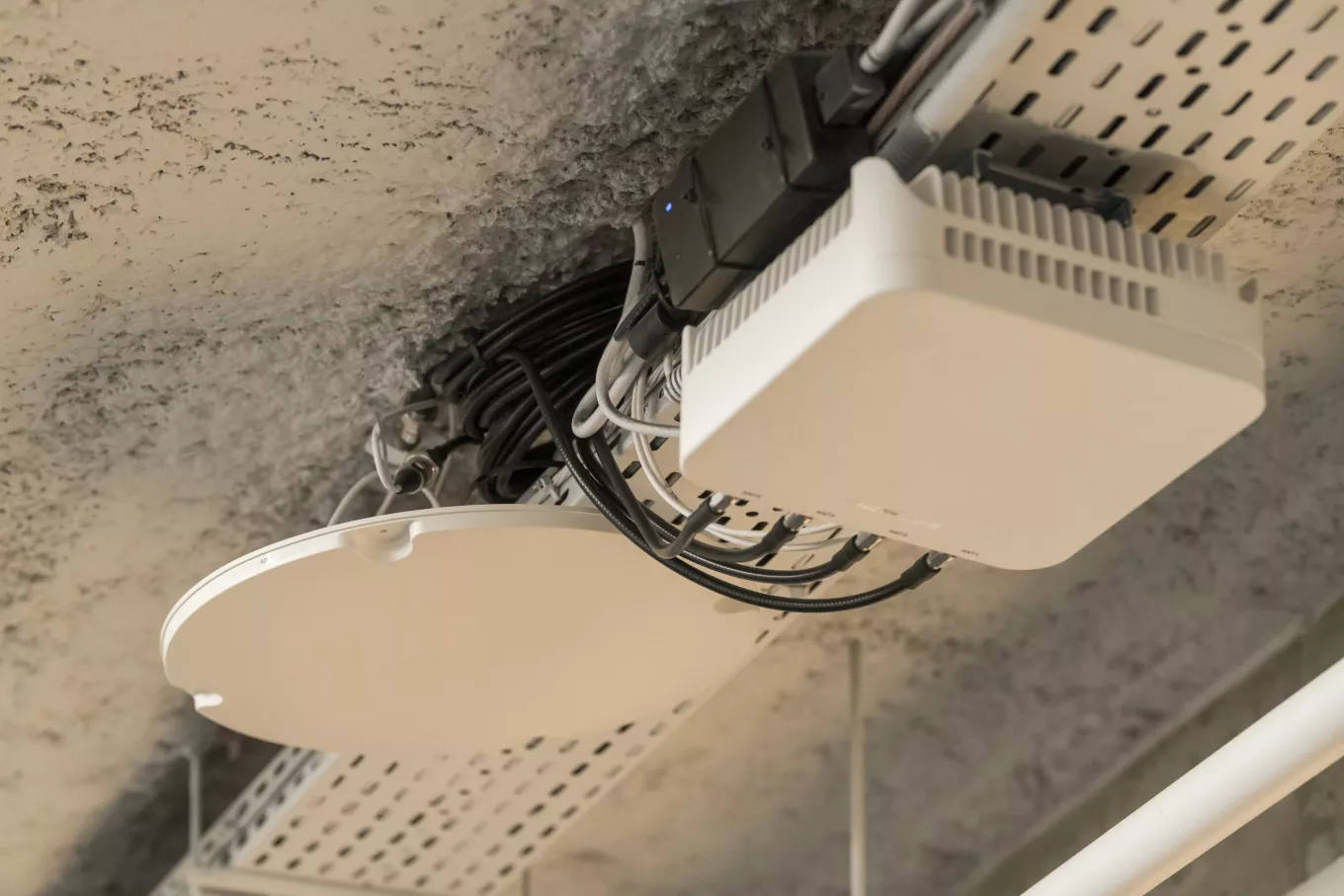
When outdoor coverage is insufficient, Equans deploys indoor coverage infrastructure. These systems distribute mobile network coverage throughout the building. These solutions are based on distributed antenna systems (DAS), tailored to each specific configuration:
- Passive DAS: for small buildings, offices, and retail spaces. Coaxial cables and splitters, without amplification; limited scalability.
- Hybrid DAS: for medium-sized buildings, commercial properties, and parking garages. Fiber optics and coaxial cables; medium to high scalability.
- Active or digital DAS: for large real estate complexes, campuses, or shopping centers. Fiber optics and radio units; high scalability, 5G-ready.
These infrastructures ensure uniform coverage, thanks to an architecture tailored to each building. They cover offices, meeting spaces, industrial sites, public-access facilities, parking garages, and basements.
Compatible with multiple mobile carriers, they support the evolution of GSM (second-generation mobile network), 4G, and 5G networks. Their design incorporates the 3.5 GHz band, which is less attenuated by building materials. This ensures the long-term value of your investment.
Enterprise Wi-Fi Networks
Enterprise Wi-Fi is an essential complement to mobile networks inside buildings. A business Wi-Fi network connects workstations, visitors, industrial equipment, and connected devices.
To ensure an architecture tailored to your needs, our teams provide:
- Wi-Fi radio studies;
- coverage audits;
- sizing of professional Wi-Fi access points;
- Wi-Fi installation and deployment of Wi-Fi access points;
- performance optimization;
- network maintenance and operation.
Wi-Fi networks can also take over from mobile networks thanks to VoWiFi (Voice over Wi-Fi): calls and text messages then go through Wi-Fi, ensuring uninterrupted communications for your teams. We also deploy low-bandwidth networks tailored to building services, depending on usage.
Geolocation of People and Equipment
Beyond connectivity, a building’s radio infrastructure provides new digital services. Indoor geolocation solutions make it possible, in particular, to:
- locate critical equipment;
- track mobile equipment;
- facilitate maintenance operations;
- to improve traffic flow management;
- to enhance occupant safety;
- develop smart building services: wayfinding, occupancy detection, and comfort.
These services rely on existing connectivity infrastructure. They transform the building into a digital platform that serves its occupants.
Audit, 4G and 5G DAS, enterprise Wi-Fi, geolocation: Let’s work together to build indoor coverage for your building
Our expertise in indoor coverage, by the numbers
Throughout France, our experts deploy indoor mobile coverage solutions in commercial and industrial buildings and large retail spaces ranging from 20,000 m² to 90,000 m².
In 2019, we installed 440 antennas on an office campus.



Frequently Asked Questions About Indoor Coverage
Why is cell service poor in some buildings?
Reinforced concrete, steel structures, and thermally insulated glazing significantly limit the penetration of radio signals into buildings. The energy requirements of RE2020 exacerbate this phenomenon, sometimes creating “dead zones”—areas without mobile coverage.
What is the difference between indoor cellular coverage and Wi-Fi?
Indoor cellular coverage allows users to access their carrier’s GSM, 4G, and 5G networks inside a building. Wi-Fi is a local network that connects computer equipment and devices to the Internet or to company resources. The two are complementary.
How can indoor cellular coverage (4G and 5G) be improved in a building?
Improvements are based on several factors: radio audits, optimization of signal penetration through the building envelope, and the deployment of a suitable infrastructure. Our experts design the most appropriate solution for each client, ranging from a simple repeater to a complete infrastructure.
What is a distributed antenna system (DAS)?
A distributed antenna system (DAS) provides mobile network coverage throughout a building using antennas distributed throughout the space. It captures the signal from mobile network operators and distributes it via coaxial cable or fiber optics to ensure uniform coverage.
What is the difference between a DAS and a femtocell?
A DAS (distributed antenna system) broadcasts signals from multiple carriers over a vast network of antennas to cover large areas. A femtocell covers a limited area with a single small radio cell. For large commercial buildings, DAS is generally the preferred solution.
Which buildings need an indoor retractable roof?
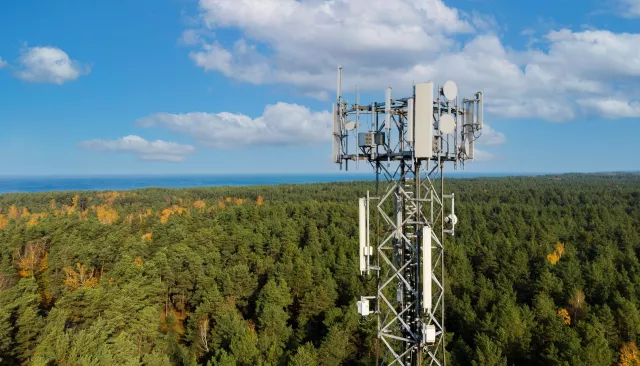
Indoor cellular coverage is designed for office buildings, industrial sites, campuses, healthcare facilities, shopping centers, train stations, transportation infrastructure, and public buildings. More generally, it is intended for any building where the cellular signal is insufficient to meet the needs of the occupants. For outdoor spaces and large sites, explore our outdoor wireless network offerings.
Does 5G require specific infrastructure inside buildings?
Yes. 5G frequencies, particularly the 3.5 GHz band, have a more limited range and are more heavily attenuated by building materials. Their deployment often requires specific radio design and appropriate infrastructure to ensure consistent coverage throughout the building.
How is a mobile and Wi-Fi coverage audit conducted?
The audit begins with on-site measurements of existing signals. Our engineering teams analyze the data, create a coverage map, and identify areas with poor reception in order to determine the technical solutions best suited to each client’s specific needs.
How does geolocation work inside a building?
Indoor geolocation relies on radio technologies deployed within a building to determine the real-time location of people, equipment, or assets. It improves operational management, enhances occupant safety, and facilitates the tracking of resources.
Can Wi-Fi replace cell service?
Not entirely. Thanks to VoWiFi, Wi-Fi can carry your employees’ calls and text messages. But only mobile coverage guarantees uninterrupted communications while on the go and for all devices, including those used by visitors. The two networks are complementary.

Talk to our indoor roofing experts
Whether it’s a dead zone, a new construction project, or a renovation: our experts assess your coverage and design the right solution—business Wi-Fi, indoor 4G and 5G coverage, or indoor geolocation. We support every client from the initial assessment through maintenance. Property managers, businesses, and local governments: let’s discuss your indoor connectivity project together.Talk to our indoor roofing experts
Whether it’s a dead zone, a new construction project, or a renovation: our experts assess your coverage and design the right solution—business Wi-Fi, indoor 4G and 5G coverage, or indoor geolocation. We support every client from the initial assessment through maintenance. Property managers, businesses, and local governments: let’s discuss your indoor connectivity project together.