Land-based and naval radomes: protection without compromising performance
Land-based and naval radomes: protection without compromising performance

To ensure that an antenna can operate under all conditions—storms, frost, hail, snow, heat, salt air, sand—without sustaining damage or compromising its signal, it takes more than just a fairing.
The radome is a composite enclosure designed to protect theantenna, while allowing the electromagnetic waves it emits or receives to pass through. It must neither reflect, attenuate, nor distort them.

In Morlaix, Ineo Defense designs and manufactures custom radomes for the civilian and military sectors. Their purpose: to enable a weather antenna to continue operating during heavy snowfall, a ship to maintain communications on the high seas, or an air traffic control radar to transmit in all weather conditions.
That is why the materials, shape, thickness, and type of assembly vary from one radome to another. Some must withstand 350 kg/m² of snow, winds of 320 km/h, and temperatures ranging from -49 °C to +55 °C, while maintaining stable radio performance. Ground-based radomes can reach up to 18 meters in diameter.
Since its inception, the Morlaix facility has manufactured several thousand radomes, including more than 190 large radomes already installed across six continents, in a variety of environments: at high altitudes, in tropical regions, in saline environments, or in sensitive civilian areas.
This expertise is now recognized as the gold standard, even under extreme high-mountain conditions, in war zones, or in areas exposed to tropical cyclones.
Several thousand radomes designed by the Morlaix facility, including 190 large radomes, have been installed on all 6 continents.
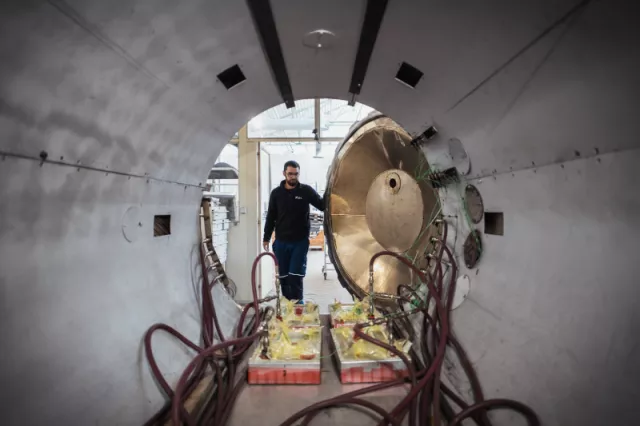
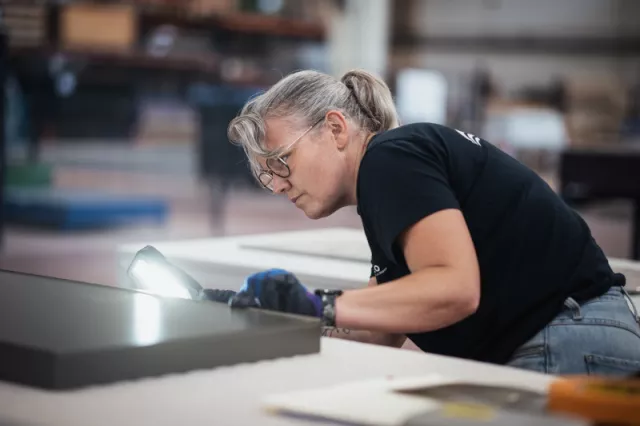
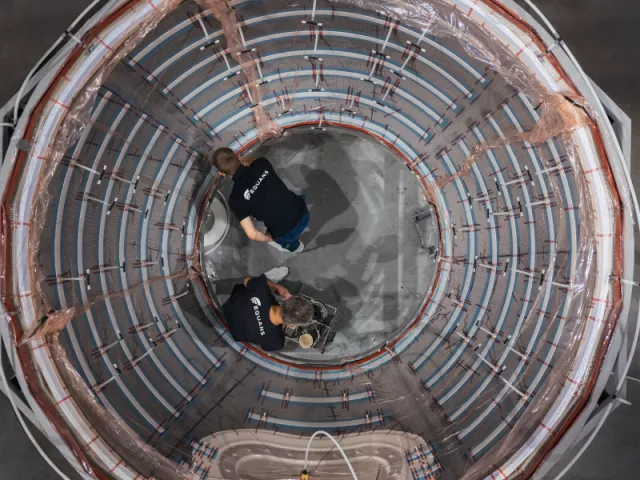
The manufacturing process takes place in a cleanroom, a controlled environment where temperature, humidity, and dust levels are regulated to ensure the integrity of the materials. The layers—fiberglass, foam, resin, and gelcoat—are assembled by hand.
For certain very high-frequency configurations, the processing temperature is controlled to within one degree, to ensure stable dimensional stability and consistent electromagnetic properties.
Throughout the process, test benches are used to validate materials, test panels individually, and ensure final transmission performance.
Every part delivered is the result of a delicate balance between physical strength, long-term stability, and signal transparency.
Without this transparency, the performance of the antennas they protect would be significantly impaired.

Composite haute couture: custom-made to the nearest hundredth of a millimeter
A weather radome, designed for precipitation detection radars, typically consists of several layers of fiberglass, each 10–15 mm thick. It is optimized for mechanical strength, wind resistance, and light weight, while ensuring radio transparency suitable for standard frequency bands.
A SATCOM radome (designed to protect a satellite communications antenna), on the other hand, can incorporate up to 25 composite layers, with a similar thickness, to enable distortion-free transmission in the 7 to 32 GHz bands. The thickness and properties of each layer are calculated based on the signal to be transmitted.
The stacking order, materials, their density, and their impregnation are all considered as adjustable variables. Each part thus becomes a custom-made structure, designed with micron-level precision. This approach to composite engineering relies as much on industrial precision as on technical craftsmanship.

Météo France Radomes: Gaining 50 km for More Effective Alerts

Since 2008, Ineo Defense has been designing, manufacturing, and installing radomes for Météo France to protect the radar antennas at its weather monitoring stations, both in mainland France and in the overseas departments and territories.
To date, 35 radomes have been deployed, in three different diameters (6.20 m, 6.80 m, and 9.5 m), to accommodate the various types of observation sites.
Thanks to their perfectly calibrated electromagnetic transparency, these radomes have made it possible to extend the radar detection range from 200 to 250 km, without disrupting the antenna’s operation.
This technical advancement has very concrete benefits: more accurate forecasting of heavy precipitation, earlier detection of flooding, better forecasting of snowstorms or high winds, and improved air traffic safety.
By protecting the antennas without obstructing them, radomes allow the signal to “see farther,” more accurately, and for longer.
DGAC: Protecting the Radar Systems That Ensure Air Traffic Safety
For more than thirty years, Ineo Defense has been designing, manufacturing, and installing radomes for the DGAC to protect critical air navigation antennas while ensuring complete electromagnetic transparency.
This equipment ensures the proper operation of two types of radar essential to traffic safety: ATM (Air Traffic Management), used to monitor airspace and detect aircraft at a distance, and ILS (Instrument Landing System) antennas, which assist pilots during approach and landing phases, even in poor visibility. In both cases, the reliability of the radar signal is an absolute imperative.
Radomes protect these antennas from environmental conditions that could damage them or disrupt their operation: flying debris, inclement weather, jet blast, or even corrosion and temperature fluctuations. Two flagship projects illustrate this collaboration: the construction of three 40-meter-long ILS radomes, incorporating “crushable” structures designed to deform in the event of a collision to minimize risks to aircraft, and the manufacture of 30 ATM surveillance radomes.

The design and manufacturing quality of Ineo Defense radomes has far exceeded initial expectations: although the contractual service life was set at 20 years, the very first radome delivered in 1993 is still in service today, having required no major maintenance in 30 years.
Morlaix, at the heart of the French Navy's strategic communications
As part of the Syracuse IV military satellite communications program, Ineo Defense designs and manufactures SATCOM antennas and radomes in Morlaix for the French Navy’s flagship vessels.
This equipment ensures the transmission of strategic data between units deployed at sea and command centers via secure X- and Ka-band links.
They are deployed on defense and intervention frigates (FDI), air defense frigates (FDA), multi-mission frigates (FREMM), amphibious helicopter carriers (PHA), force replenishment ships (BRF), and the aircraft carrier Charles-de-Gaulle.
These systems are designed to remain fully operational in rough seas, while underway, or in the event of jamming. The radomes are sized to protect the antennas without interfering with their electromagnetic operation. Their design meets enhanced requirements for mechanical strength, waterproofing, resistance to the marine environment, as well as resilience against shock waves or blast waves.
This expertise is not new. Ineo Defense was also involved in the design and manufacture of radomes for the Syracuse III program, a major milestone in the evolution of the French forces’ onboard communication capabilities. These solutions strengthen the operational resilience of the French naval forces, while ensuring NATO interoperability, a high level of performance, and the ability to maintain continuous communications under extreme conditions.