Aeronautical Radomes and Maintenance: Onboard Precision, Controlled Lifecycle
Aeronautical Radomes and Maintenance: Onboard Precision, Controlled Lifecycle

At speeds exceeding Mach 1.8, even the slightest irregularity becomes a weakness.
In the aerospace industry, radomes must not only protect onboard sensors: they must also ensure aerodynamic efficiency, withstand impacts and pressure fluctuations, and not interfere with the aircraft’s electromagnetic signature.
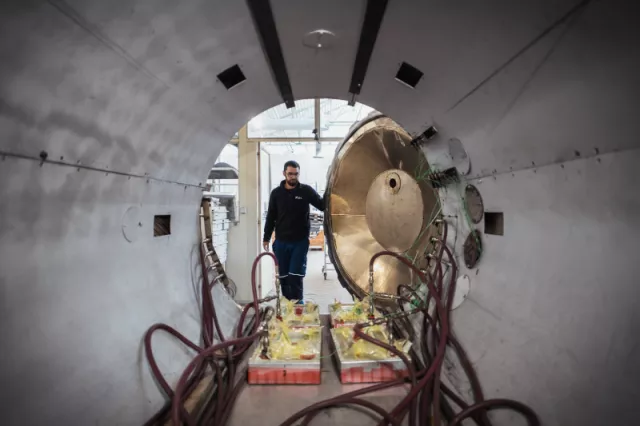
In Morlaix, Ineo Defense manufactures and maintains radomes for both military and civil aviation. Each part is made from high-performance materials (quartz fibers, engineering resins) and cured in a high-pressure autoclave to ensure stability, lightness, and durability.
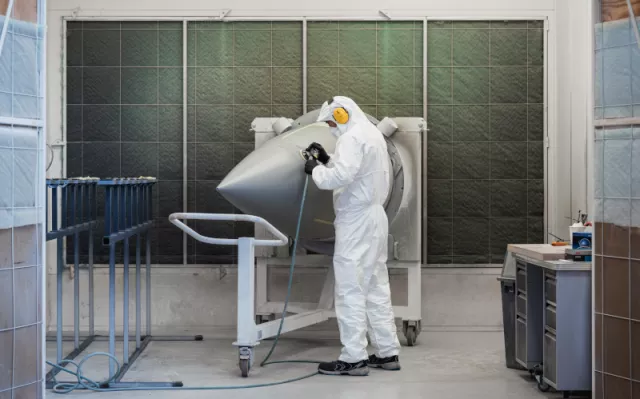
The finishing—particularly the painting—is done entirely by hand.
Even the slightest impurity can alter signal reflection or compromise an aircraft’s stealth capabilities.
These radomes are designed for extreme environments: supersonic flight, high mechanical stresses, hail or bird strikes, and severe thermal gradients.
Requirements vary greatly between an Airbus nose and a Rafale radio-electronic fuselage section, but the principle remains the same: to ensure protection without disrupting the sensor’s function.
In addition to new manufacturing, Ineo Defense has a comprehensive maintenance and repair capability.
Each year, dozens of radomes are inspected, refurbished, and recertified at the Morlaix site.
The company works on a wide range of products—from commercial aviation to defense—with the same standard: restoring the part to its original specifications, both mechanical and electromagnetic.
These radomes are designed for extreme environments: supersonic flight, high mechanical stresses, hail or bird strikes, and severe temperature gradients.

A radome that meets the demands of aerial combat
The Rafale defense systems rely on sensors protected by high-performance radomes, one of which is manufactured in Morlaix. This radome must ensure both electromagnetic stealth and mechanical strength at very high speeds. Each part requires more than a week of work, from molding to final inspection. In response to rising demand, production rates on this line have more than doubled.
Bringing Civilian and Military Radomes Back into Service: A Time-Tested Expertise
Since the 1970s, hundreds of radomes—both civilian and military—have passed through the workshops of Ineo Defense. While these parts are initially manufactured in southern France (by SIAé), in Nantes (by Airbus), in the United States (for Boeing), or elsewhere in Europe, Ineo Defense is now one of the approved repair organizations responsible for their refurbishment (PART 145 and FAR 145 certification).

This expertise pertains in particular to the nose cones of fighter jets or transport aircraft, as well as the nose radomes of civil aircraft from Airbus, Boeing, Bombardier, or ATR, which house weather or landing radars.
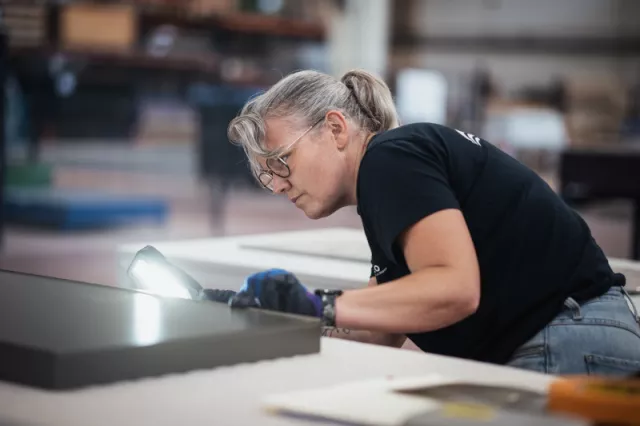
Each part is first inspected and measured, then structurally repaired and finally repainted. Some require up to eight different coats of paint to restore their physical, aesthetic, and radio-electrical properties.
The final phase—a comprehensive electromagnetic test—ensures that the radome is once again fully functional before it is returned to the fleet. The work can take anywhere from a few days to several months depending on the scope of the repairs and inspections required. Once refurbished, the radomes can be reinstalled directly onto the aircraft, without going through an intermediary.