ANTENNAS: COMMUNICATE, DETECT, QUERY
ANTENNAS: COMMUNICATE, DETECT, QUERY

As a central component of detection and communication systems, the antenna converts electrical signals into electromagnetic waves, and vice versa.
It can be designed to detect a target (primary antenna), interact with it to identify a device as friend or foe (IFF / secondary antenna) or even transmit data over very long distances (SATCOM, for satellite communication).
Each application imposes specific technical constraints: onboard environment, security, discretion, frequency, range, or mobility.

©Atypix
In Morlaix, antennas are custom-designed to meet these needs in a variety of environments – civil air traffic control radars, French Navy surface vessels, fighter jets, or mobile stations.
Ineo Defense covers the entire value chain, from design to final testing. The design division engineers each antenna based on precise electromagnetic and mechanical simulations.
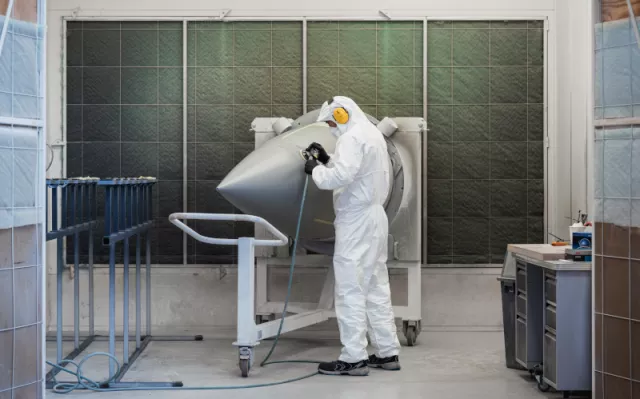
Manufacturing is carried out locally: assembly of microwave sources, wiring, surface treatment, and technical painting.
Since 2024, production lines have been reorganized to meet increased demand, particularly in the field of military radar, where production rates have more than doubled.
The plant has also invested in metal 3D printing to address the challenges associated with the increasing frequency of antenna systems. Today, next-generation equipment—such as that used in the Syracuse IV —the French military communications system using geostationary satellites—operate in frequency bands ranging from a few gigahertz to several tens of gigahertz. Multifrequency capability allows for simultaneous communication across multiple frequency bands within a compact space, without altering the structure. To meet these requirements, Ineo Defense now uses certain passive microwave components manufactured using additive manufacturing—waveguides, couplers, filters—that are typically machined in multiple parts. This method offers greater lightness and precision, and significantly reduces assembly time while optimizing radio frequency (RF) and mechanical performance.
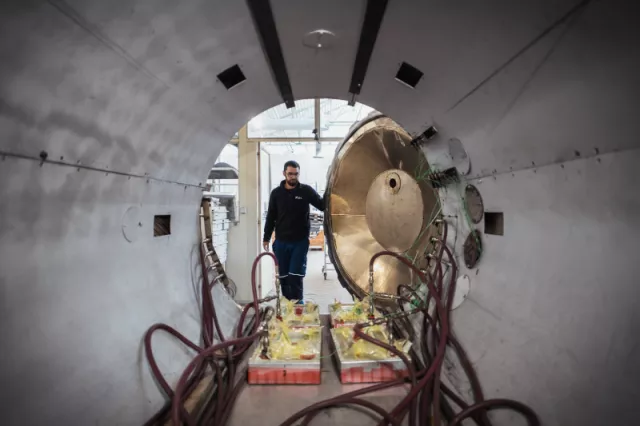
Each antenna is then subjected to a series of rigorous electromagnetic tests. These tests are conducted primarily in anechoic chambers—enclosed spaces partially or fully lined with absorptive materials—designed to eliminate all reflections and parasitic noise. This type of environment simulates free-space propagation conditions in order to measure the antenna’s actual radiation performance without detrimental external interference.
Near-field and far-field test benches complete this testing phase. They enable the precise characterization of directivity, gain, beam stability, and frequency response. These steps are essential to ensure the equipment functions properly once integrated into its operational environment, whether it is a ground-based radar, a ship, or an aircraft.
Antennas cut to the hundredth
In certain antenna systems designed in Morlaix, parabolic reflectors play a central role: they concentrate and direct the radio beam with a very high degree of precision. This component is essential in antennas with very high directivity, such as those used for satellite communications on surface vessels or at ground stations.

This is essential to ensure signal directivity, particularly in the highest frequency bands (up to 32 GHz).
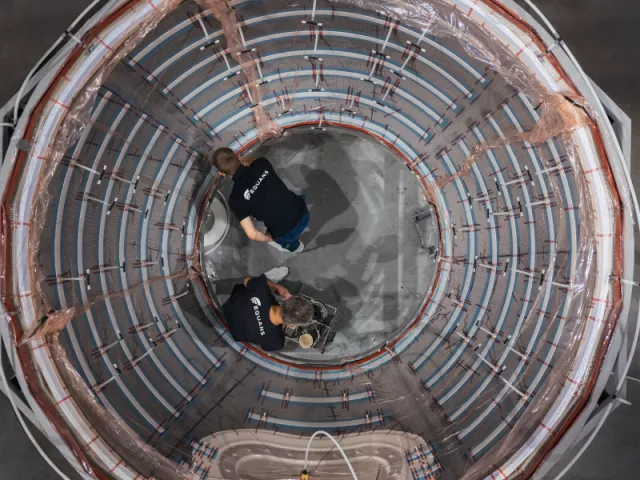
Made of carbon fiber, these reflectors combine light weight, rigidity, and thermal stability. Some antenna models are equipped with dynamic pointing systems capable of maintaining real-time alignment with a satellite, even when the carrier is in motion.
This expertise is applied to both civilian and military systems, notably as part of the Syracuse program and for equipment used on French Navy vessels.
Radar Antennas: Accelerated Industrial Growth in Morlaix
Ineo Defense is a recognized industrial partner in the manufacture of secondary antennas for civilian and tactical radars.
In Morlaix, its teams produce, among other things, antennas integrated into air traffic control radars, deployed for in-flight tracking or at high-traffic airports. For one of these models, between 10 and 20 units are manufactured each year, entirely on-site, with a high level of finish.
The facility also contributes to the manufacture of secondary antennas for mobile surveillance and air defense radars, designed for detection missions, airspace coverage, or the protection of sensitive areas. For certain tactical models, the production rate was doubled in 2024, with each system assembled, tested, and qualified on-site prior to delivery.