
Energy Efficiency: What if We Recovered Heat to Cool the Planet?
Decarbonizing industry—as well as district heating networks—is an urgent challenge at a time when calls for energy conservation are growing as winter approaches. From optimization and fluid performance to waste heat recovery, innovations in heat pump technology make them a key to the future.
They offer numerous environmental and economic benefits while meeting regulatory requirements. The implementation of these innovative solutions is supported by a favorable environment thanks to French and European subsidies under investment and stimulus plans.

Heat Pumps and Industry
How can we balance the significant cooling and heating needs of strategic industries such as food processing and chemicals with increasingly stringent energy constraints?
Industrial processes require energy, heat, and/or cooling. Certain production processes simultaneously require alternating cycles of heat and cooling. This is particularly true for the food industry—especially dairy products, meat processing, fruits and vegetables, malting, beverages, and canning—as well as for the fine chemicals and pharmaceutical industries with their synthesis cycles, and for the paper industry.
The food processing industry is known for minimizing all forms of waste, particularly of raw materials. Given the current strain on energy markets, this has become a determining factor not only because of the significant rise in costs, but also due to threats to supply and the risk of gas shortages in the coming months.
The purpose of refrigeration units installed in industrial processes is to remove heat. This is what makes it possible to process a component or food product, or to lower and stabilize the temperature of a cold room. The removed heat is usually lost, as in conventional air conditioning systems that blow cold air into a room while expelling heat.
The principle of a heat pump is to recover this heat from refrigeration systems, raise its temperature, and reuse it in another part of the industrial process. Using a heat pump makes it possible to recover waste heat for industrial processes as well as for district heating networks.
The goal is to protect against rising energy prices while reducing greenhouse gas emissions and ensuring independence from fossil fuels.
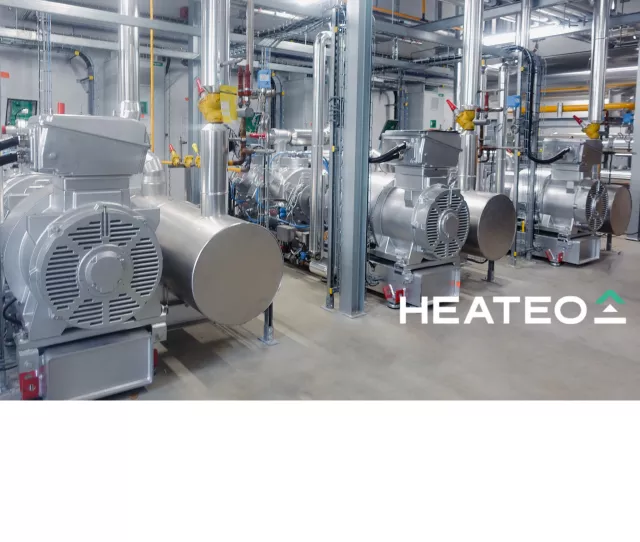
How a Heat Pump Works: A Tool for Energy Management
Heat pumps are therefore an efficient way to recover and generate heat from energy drawn from the environment—specifically from the air, the ground, and groundwater—through solar radiation, wind, and precipitation. The heat pump operates in a closed loop containing a refrigerant that evaporates and condenses depending on the pressure and temperature of the loop. To generate heat, the refrigerant absorbs waste heat from industrial processes and refrigeration systems. The refrigerant is then vaporized and compressed, thereby increasing its temperature. The heat from the vaporized refrigerant is captured by a heat exchanger, allowing water to be heated up to 120 degrees, which expands the range of applications throughout the process.

While energy self-sufficiency and independence are major concerns for manufacturers, heat pumps do not require fossil fuels. They are also three times more efficient than combustion, with coefficients of performance ranging from 3 to 4.
In fact, they use a free raw material: waste heat. Furthermore, its various components are energy-efficient. The result: energy and environmental efficiency, reduced and optimized consumption with no waste, powered by a carbon-free electricity supply that is far less susceptible to disruptions than natural gas.
Furthermore, thanks to support mechanisms that recognize its environmental benefits, the return on investment is less than two years, which enhances the appeal of this technology among manufacturers.
Outlook and Challenges Ahead
How can you optimize refrigeration or heat-generation systems that consume a particularly large amount of energy?
Heat pumps can not only replace fossil fuels but also recover waste heat and utilize it by feeding it back into the manufacturing process.
In France, energy use in industry totals 426 TWh, according to data from ADEME (the French Environment and Energy Management Agency). Applications operating below 120° that use fossil fuels account for one-quarter of this energy consumption. The agri-food, pharmaceutical, and fine chemicals industries account for 30% of this energy use. The recovery of waste heat from refrigeration and cold air compression systems is estimated at 34 TWh.
Thus, the potential use of heat pumps in industry can be estimated at 130 TWh, or more than one-third of the energy currently used.
The international context and economic situation are driving many stakeholders to integrate heat pumps into their industrial processes. However, it is essential to rely on expert knowledge to determine where to reinject this heat and preserve the benefits and advantages of the technology.
At Richesmonts, the results speak for themselves!
The teams at Axima Réfrigération worked with Compagnie des Fromages & RichesMonts (CF&R), which produces the famous Camembert, Coulommiers, Brie, and raclette cheeses. Following an energy audit conducted in 2015, the company decided to improve its energy efficiency. A heat pump was installed along with a heat and cold recovery system to recover waste heat and reuse it in the production cycle. In fact, the production of soft cheeses requires a large amount of cooling, the generation of which previously resulted in the discharge of water at 50°C. However, the industrial process also required large quantities of hot water at over 80°C, primarily for pasteurizing the milk.
The installation of a heat pump was closely monitored to assess its benefits. The results speak for themselves: nearly 4,300 MWh of waste heat recovered in the first year alone, with a projected total of 5,700 MWh—equivalent to a 23% reduction in gas consumption, or more than 1,000 metric tons of CO₂ avoided each year.
Technology tailored for district heating systems
To power its district heating network, Amiens has installed a heat pump to recover the heat present in the water from a wastewater treatment plant. Using a heat exchanger, the system recovers thermal energy, which is then fed back into the Amiens Énergies network.

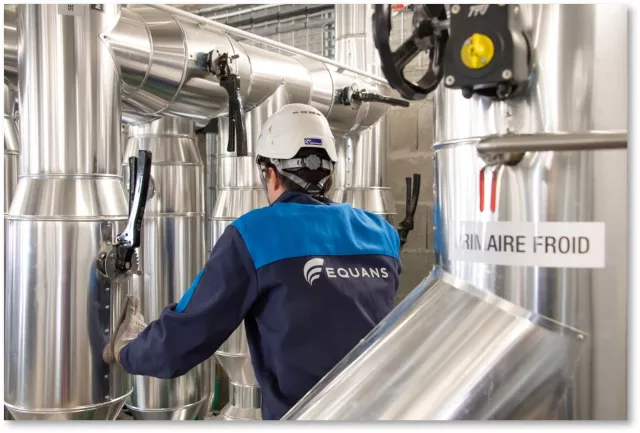
Axima Refrigeration
A specialist in refrigeration systems and HVAC engineering, Axima Réfrigération is a division of Equans France, a global leader in multi-technical services, and has over 15 years of experience in the use of heat pumps for industrial applications.
The experts at Axima Réfrigération have a thorough understanding of the technology and are able to integrate it in a customized manner into each industrial process.This involves measuring and mapping heat recovery to optimize its use by first identifying existing sources and needs.
Working closely on the ground, the teams receive ongoing training to support financing efforts and secure grants thanks to their in-depth knowledge of regulations.

Do you have a need? Let's talk about it!
Do you have a need? Let's talk about it!
