
News 2022-04-11
February 16, 2022
Becton Dickinson: A Successful Move with the Installation of a New Capacity Expansion in the Midst of the COVID-19 Crisis
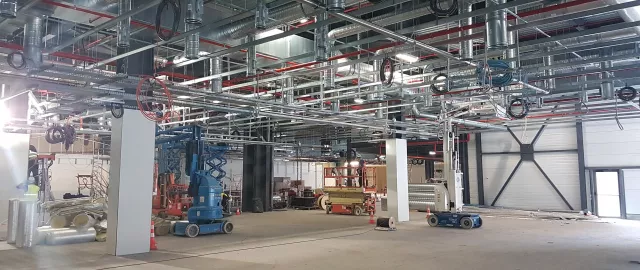
An expansion designed to address the challenges of combating COVID-19, among other things
As a global medical technology company, the American giant Becton Dickinson has been constantly innovating since its founding. In Pont-de-Claix, in the Isère department, its production facility for syringes and piston seals—a reflection of its ambitions—has already undergone an extraordinary renovation. In 2020, to address the challenges posed by the fight against COVID-19 in particular, the company partnered with EQUANS to build a factory expansion—all while keeping operations running at a site that was bustling with activity!
A unique “energy hub” has already been built to power the plant
Each year, more than 330 million glass syringes and 1,800 million piston seals are manufactured in Pont-de-Claix and then shipped to nearly 300 countries. Syringes and plunger seals are two strategic products that require a high level of R&D and engineering, both in terms of technology and manufacturing processes. A single “grain of sand” is all it takes to bring the entire chain to a halt. To meet Becton Dickinson’s growth ambitions, it was necessary to overhaul the entire production and utility distribution chain, which relies on a multitude of small units, each very different from the others.
Equans France undertook the design and construction of a turnkey facility at this site, comprising 18,000 m² of workshops and 4,000 m² of cleanrooms on nearly 10 hectares of land. A true strategic “hub,” the 300 m² building—adjacent to the manufacturing site—centralizes all heat, cooling, and electricity production in a single location and then redistributes the energy generated.
Since the multitude of units compounded maintenance issues without guaranteeing optimal performance, the decision was made to consolidate the various units into a single location. This “energy hub” features three chiller units, including two Quantum chillers with magnetic bearings. A 1.3 MW Quantum water-cooled chiller completes the system. In addition, a gas-fired boiler room distributes thermal energy to the site’s 50 air-handling units. Needless to say, this is a critical aspect, as no temperature errors are permitted in this controlled environment!
“ Above all, CUP is a contractual commitment based on a price and a schedule. Throughout the project, the client has a detailed overview of their project, with no unpleasant surprises. It truly saves time, money, and improves performance. ”
How can we successfully build a factory expansion while keeping operations running at a site that’s bustling with activity?
To meet Becton Dickinson’s request, starting in 2020, to increase its production capacity for glass syringes without interrupting ongoing production—even as we were dealing with the pandemic— Equans responded with an agile approach while leveraging its multi-disciplinary expertise.
Equans’ experience in the operational management of this type of project proved decisive. The challenge? To construct a new 1,000 m² building on the existing site, adjacent to the main production unit, and ensure the continuity of team operations and production, as well as the continued operation of the power systems. Despite the project kicking off in the midst of the first wave of the pandemic, halting operations was, of course, out of the question, as energy systems played a crucial role. The work had to be carried out in phases, with particular attention paid to ensuring the safety of personnel.

A bold and successful gamble!
Drawing on its expertise in a wide range of technologies and its operational flexibility, the group was involved in all phases of the project: building design (demolition, excavation, civil engineering, steel structure, exterior cladding), construction (clean concept, ventilation of controlled environments, heating, air conditioning, and management of fluids and utilities necessary for the proper operation of the expansion).
Given this highly specialized environment, which operates concurrently with the main production unit, special care was taken to ensure personnel safety and to maintain operational conditions in the controlled environments through HVAC systems, fluid and utility systems, and the protection of the facilities, as well as our low- and high-voltage electrical systems.


