
Army: How Can We Ensure Self-Sufficiency in Drinking Water in the Field?
Having access to drinking water in the field is a strategic priority for the Army. The Mobile Water Treatment Plant (STEM), designed by Equans France in collaboration with Suez under a contract with the DGA (Directorate General for Armaments), produces drinking water from water available in the field. Explanations.
Key Figures
Key Figures
A system that adapts to all types of water
It took three years to develop the mobile water treatment plant, the result of a collaborative effort between industrial teams and the Ministry of the Armed Forces (DGA, Army, SIMMT), including the Armed Forces Health Service (SSA) and veterinary services. The plant can treat all types of water, including brackish water, seawater, uncertified water sources, and water containing potential sources of uncontrolled pollution. Its major advantage lies in its highly compact design, which makes it suitable for deployment at sensitive sites. The innovative water treatment and monitoring processes used ensure a very high level of quality.

Innovative processes that meet the needs of the field
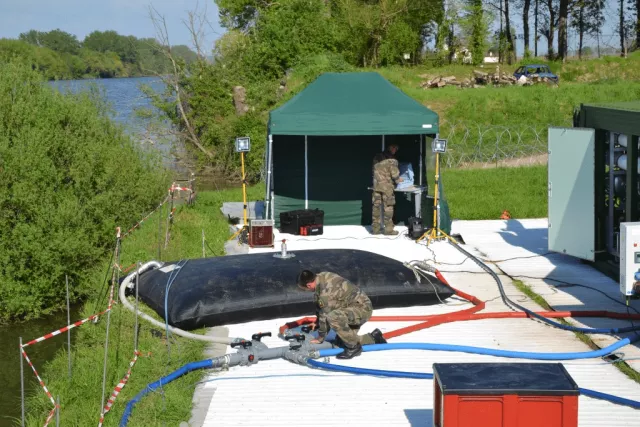
The water is first drawn from the river and stored in a 20,000-liter tank, which houses the raw water pump for the treatment system. Four stages are then required to make the water safe to drink.
First, the water is pumped to the initial pre-filters, which remove the coarsest suspended solids. It then passes through ultrafiltration membranes to remove virtually all bacteria. The third stage removes viruses and unwanted particles from the water using a reverse osmosis system. The fourth and final phase involves passing the osmosis-treated water through cartridges filled with mineral salts essential for the human body. All production phases are monitored via a control panel that manages the treatment process and ensures water quality.
A tenfold increase in processing capacity during operation
The STEM station produces an average of 6 m³ of potable water per hour, which is four times the volume produced by its predecessor, the mobile water treatment unit (UMTE). When using seawater, its capacity is reduced to 3m3 per hour. During operation, the number of tanks can be increased, thereby expanding the raw water storage capacity. Used in the Tarn region, the station produces 20,000 liters of water to meet the drinking water needs of 250 people per day. This innovation makes it possible to produce and distribute drinking water completely independently and safely, using natural sources. Its capacity to meet drinking water needs can reach up to 800 people per day.
Partner

Expertise and Services
-
Innovation in Drinking Water Treatment
-
STEM's Reverse Osmosis System Ensures Complete Water Purification