March 25, 2024
Equans Digital is showcasing two Industry 4.0 demonstrators at the Global Industrie trade show
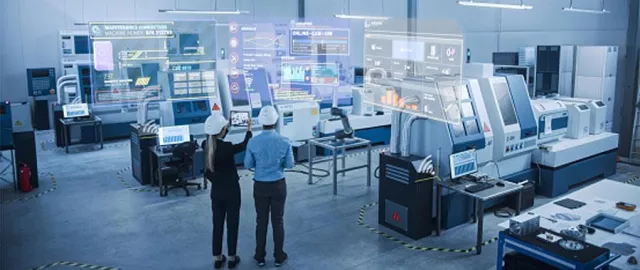
By bringing together and combining the expertise of the group’s specialized entities, Equans Digital enhances the operational performance and energy efficiency of its clients engaged in the digital transformation. At the Global Industrie trade show, Equans Digital chose to highlight two solutions for manufacturers.

Computer Vision: Artificial Intelligence and Optics for Visual Recognition

Industrial and logistics processes rely on numerous visual inspections. These low-value-added tasks are tedious due to their repetitive nature, which can lead to human error. Advances in optical technology have made it possible to automate and accelerate these steps. Standard solutions available on the market are not suitable for all needs. Equans Digital aims to provide a solution for these niche scenarios. Using a machine learning process applied to complex data (since video images are unstructured), the algorithmic model enables object recognition across all image types, regardless of wavelength, including those from infrared or thermal cameras.
In practical terms, this makes it possible to inspect products and materials and detect defects in them. Designed for texture inspection, this solution makes it possible, for example, to distinguish on a production line between the characteristics of a burger bun with and without sesame seeds. It is also possible to determine the composition of a bottle cap—whether it is made of cork, plastic, or agglomerate—or to detect anomalies in the structure of metal components. Suitable for all industrial processes—from food and beverage to pharmaceuticals and metallurgy—this solution facilitates quality control as well as monitoring the status of the production process and ensuring safety by detecting intruders in a given environment.
Seapal-C: The Collaborative Palletizing Solution
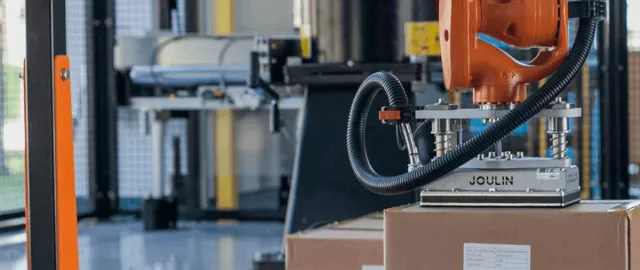
The principle of collaborative robotics is to enable an automated, autonomous process to interact with human intervention. Thus, if a person modifies the composition of a pallet being assembled by a robot—by adding or removing a package—the process can adapt in real time and continue. The Seapal palletizing software allows users to create and modify all elements of the process: package formats, assembly plans, and divider management. It ensures that the contents of the packages, along with their specific characteristics and constraints—including fragility—are taken into account. Another advantage of the solution is that the robot’s feed system can handle two packages simultaneously, each weighing up to 15 kg.